Corporate claims outstrip foreign aid to Ecuador

Countries are now being ordered to pay U.S. corporations more than they’re receiving in U.S. aid.

In October, an arbitral panel under the U.S.-Ecuador investment treaty ruled that Ecuador must pay Occidental Petroleum (a major U.S. multinational) the tidy sum of $1,769,625,000. This was the largest ever investment award at the World Bank’s center (ICSID) that handles these disputes.

Last year, my colleagues Kevin Gallagher and Elen Shrestra noted that:

in 2004, a U.S. investor won an arbitration against Ecuador an claiming an amount of damages that translated to $5.5 and $16 per capita respectively. The claimed damages per capita was equivalent to Ecuadorian aid per capita. Thus, had the U.S. investor been successful in getting the claimed amount, Ecuador payments would have been analogous to transferring aid per capita to the U.S. The award and claim amount relative to government expenditure were 1.92% and 7.5%. The importance of these numbers become clear in the light that Ecuador spends annually around 7% of their government expenditure on health.

The award they refer to is a previous 2004 case by Occidental, where the company claimed at least $201,563,930 (nearly $16 per person among the 13.2 million Ecuadorans at the time) and were ordered to pay about a third of what they requested ($71,533,649, plus interest).

Here’s the more recent case, by the numbers:

  • Ecuador has about 14.7 million people, as of 2011.
  • The U.S. spent $22.4 million on Ecuador in 2011, which works out to about $1.53 per Ecuadoran.
  • Oxy claimed at least  $2,906,200,000 in damages, which would have amounted to$198 per Ecuadoran.
  • Oxy got $1,769,625,000, which amounts to $120.66 per person, or 79 times greater than foreign aid per capita to Ecuador. This discrepancy is show in the table below.

COOL Runnings

A WTO arbitrator ruled on Tuesday that the U.S. needs to hurry up and deregulate food labels.

A quick refresher: Back in July of this year, Mexico and Canada were successful in their efforts to convince the WTO that country of origin labels (COOL) on certain cuts of meat violated U.S. obligations under the Technical Barriers to Trade (TBT) agreement. These rules are very popular with consumers in the U.S. and around the world (who want to know more about where their food comes from), and are the result of decades of  campaigning. After the U.S. agreed to comply, Canada and Mexico in September pushed the WTO to push the U.S. to come up with a compliance timeline.

This is where things get interesting: the WTO faulted the U.S. back in April for implementing tobacco regulations too quickly, and created a rule that WTO members never formally agreed to that developed country regulations affecting developing countries require a six month buffer between publication and entry into force.

The Obama administration – trying to play in good faith, as they (sometimes all too often) do – requested a minimum of 18 months to comply.

(This consisted of six months to follow the WTO buffer requirement, and an additional 12 months to go through the six stages of the regulatory process: 1) five months for internal consultations and deliberations; 2) 90 days review at the budget office; 3) publication of a proposed rule, with a 60-day notice and comment period; 4) two months to review the comments and make revisions; 5) 90 days review at the budget office on the final rule; and 6) publication. If they pursued action in Congress, it would take even longer.)

The WTO arbitrator (Giorgio Sacerdoti) ruled that the buffer only works one way: new regulations should move slowly, but deregulation should happen quickly. (para. 117)

Continue reading “COOL Runnings”

Citation nation

Today we continue our discussion of economists’ theories of law-making and ceiling building, which we kicked off by analyzing Adam Smith and Carl Menger. Suitably, we move to the neoclassical synthesis that took key concepts from both.

This may seem like an odd choice, since neoclassicals have fairly weak-to-nonexistent accounts of the emergence (and persistence) of institutions (Hodgson, 2009), so it is not surprising that they would have difficulty formulating a consistent theory on the role of judiciaries. Economist Kenneth Arrow, who generally thought that private adults consenting to exchange of commodities was preferable to other means of managing resources, and who had little confidence in the reliability of political solutions to problems (Arrow, 1950), nonetheless felt that law itself should be outside the domain of the market. (Arrow, 1972)

Much of the heavy lifting for the neoclassical account of the judiciary has fallen to one of the few actual judges in their ranks, University of Chicago law

Posner.
Posner.

professor Richard Posner. Since neoclassicals believe that their favored rational choice methodologies can help explain “everything” (Chang, 2013, Chapter 1), it is not surprising that Posner believes that these tools can also explain law and the behavior of judges. For instance, judges – just like anyone else – are self-interested individuals, and the domain of the law can be analyzed in terms of the market for legal services. (Posner, 1977, at 399 and 415) The same basic framework can explain the differing forms of justice and dispute settlement that take place in modern and in primitive societies, as Posner argues in a widely cited article with University of Chicago economist William Landes. (Landes and Posner, 1979, at 242)

This is a significant departure from Smith’s classical thought (and other neoclassicals like Arrow), which saw justice as “special,” not present in every moment of history, and saw human motivation as motivated by diverse factors like obeisance to authority. Indeed, Posner and Landes distinguish their own views from Smith’s by suggesting that he failed to understand  how “the provision of judicial services precedes the formation of the state; that many formally public courts long had important characteristics of private institutions (for example, until 1825 English judges were paid out of litigants’ fees as well as general tax revenue), and that even today much adjudication is private (commercial arbitration being an important example).” They further note that many disputes are settled out of court, and are privately financed in any case, suggesting a strong if not dominant role of private actors. (Landes and Posner, 1979, at 235) Not only does law not need the state, but even apparently state-generated law may be driven by private actors.

Law plays a special role…

Posner has difficulty reconciling how justice is “not special” with its unique structural role in contemporary life. While it can be analyzed from a market lens, the legal system seems to also hover above or alongside the market. Posner writes that, “…economics is the deep structure of the common law, and the doctrines of that law are the surface structure. The doctrines, understood in economic terms, form a coherent system for inducing people to behave efficiently, not only in explicit markets but across the whole of social interactions.” (Posner, 2010) The common law is a system that helps maximize social wealth. In settings where transaction costs are low, law creates incentives for people to channel transactions through markets, by creating property rights and enforcing remedies. In high transaction costs settings, the law prices behavior so as to simulate the allocation of resources that would have held in a market.[i] While market allocation is still superior to legal allocation,[ii] the “aloof disinterest of judges” simulates the “invisible hand” of the market (Posner, 1977, at 401).

Continue reading “Citation nation”

Making Trade Work for Public Health

(HuffPo originally published this article.)

Tobacco use is the leading preventable cause of death in the world today. Developing countries are now the top tobacco-consuming nations, where men and women are addicted to tobacco at higher rates than in developed countries, and have less success stopping.

Nations have responded in domestic law by implementing warning labels and anti-teen smoking measures, and in international law through the World Health Organization’s Framework Convention on Tobacco Control.

But international law may actually be hurting as much or more than it’s helping.

Earlier this year, the World Trade Organization (WTO) ruled against US efforts to reduce teen smoking. Elsewhere, tobacco multinational Philip Morris is using international investment treaties to target so-called plain-packing laws in Australia and Uruguay. Philip Morris has also been supportive of three pending challenges of the Australian legislation at the WTO.

In this month’s Transnational Dispute Management journal, I explore the first dispute, over the 2009 Family Smoking Prevention and Tobacco Control Act…

(To continue reading, please go to the Gates HuffPo page.)

Seeing by eye shutting

The “Ron Paul Revolution” amazes me.

How in the heck did the guy manage to make the Austrian school of economics something that could rile up emotions?

We’ll try to get to the bottom of that in the fourth in our series of posts on theories of judges and law.

Carl Menger (1840-1921) founded the so-called Austrian school of economics. His work was a response to classical economics, the German Historical School of economics, and the German Historical School of law. A classic in this field was Menger’s 1883 “Investigations into the Method of the Social Sciences with Special Reference to Economics.”

Contra classical thought, Menger wrote that Smith was insufficiently individualist in his orientation. Rather than examine social classes or the “wealth of nations,” Menger proposed that a more “exact science” would be to reduce “complicated phenomena to their elements” and see the nation as “the results of all the innumerable individual economic efforts in the nation.” He called this a “genetic” orientation to knowledge (Menger, 1986, at 93-94)

The German Historical School of economics had also criticized Smith, saying that history and empirical research had to inform economic understanding, since the Smithian self-interest or invisible hand were not universal or generalizable. Menger sarcastically noted that Smith did not assume self-interest was the only human motivation,[i] but went ahead in a memorable passage to say that history and complex motivations had no role in economic (i.e. “exact”) science:

“the difficulties resulting from the atypical character of phenomena for the realistic orientation of theoretical research do not exist for its exact orientation, as a result of the peculiar conception of theoretical problems that prevail in the latter. Exact research reduces real phenomena to their simplest elements, thought of as strictly typical, and attempts to determine their strictly typical relationships, their ‘laws of nature.’ The empirical forms with which it operates are nonetheless thought of as strictly typical not only in respect to spatial conditions, but also to temporal ones. The development of real phenomena, accordingly, exerts no influence on the way in which exact research undertakes to solve the theoretical problem.” (Menger, 1986, at 112)

Empiricism and historical methods would lead to “just as many economic theories as there are developmental stages of economic phenomena or as there are different spatial relationships of nations at the same developmental stage.” Moreover, there would be no a priori way of limiting what phenomena to consider when examining the economy. (Menger, 1986, at 107, 111)[ii]

Despite his skepticism of relying exclusively on empiricism, Menger felt that it played a complementary role and that “exact” and “empirical” methods each had their own domain. (Menger, 1986, at 140, 145)

Menger on state and law

The German Historical School of law, for its part, also attacked atomism, but arrived at the conclusion that the state and law were organic entities existing above the individual that should not be changed. (Menger, 1986, at 91)

In contrast, Menger began all accounts with the individual, and built out from there.

Continue reading “Seeing by eye shutting”

Wealth of judges

In The Wealth of Nations, Smith adds several nuances to his account of the emergence of judiciaries. (Explored more here and here.)

He argued that judiciaries are one of the four main “duties of the sovereign” (alongside military, education (and limited public works) and funds for the dignity of the sovereign). These duties would in turn vary in intensity and character depending on the four stages of civilization (Smith, 1776).

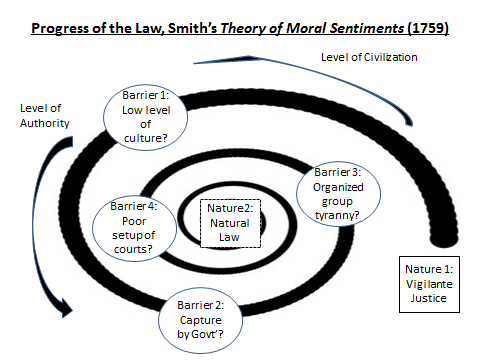
While the mechanisms of judicial supremacy are similar to his earlier accounts based on authority and utility,[i] the concrete barriers to the attainment of justice (especially Barriers 2, 3 and 4 from Figure 1) are given more detail. In medieval times, for instance, the courts were unable to administer justice, because these were essentially a way for the sovereign (who himself could not be sued) to make money through obtaining side payments from litigants (Smith, 1776, at V.1.56-1.58). With growing complexities of disputes and case backloads, the king outsources justice to his deputies, who take over the side payments. With growing complexities of public finance, the head of state has to establish a stable system of revenue. Wars, for instance, are no longer financed by the king directly, but through tax collection. (Smith, 1776, at V.1.67) For some reason that Smith leaves vague, states also simultaneously move to end the practice of side payments to the judge’s deputies. Smith does not appear to consider that this court financing shift is strictly necessary, only that it does not appear to be capable of being “effectually regulated and ascertained.” Therefore, the payments are banned altogether.

He goes on to distinguish judging from the rent-seeking activities of lawyers per se,

“Fixed salaries were appointed to the judges, which were supposed to compensate to them the loss of whatever might have been their share of the ancient emoluments of justice, as the taxes more than compensated to the sovereign the loss of his. Justice was then said to be administered gratis. Justice, however, never was in reality administered gratis in any country. Lawyers and attorneys, at least, must always be paid by the parties; and, if they were not, they would perform their duty still worse than they actually perform it. The fees annually paid to lawyers and attorneys amount, in every court, to a much greater sum than the salaries of the judges. The circumstance of those salaries being paid by the crown can no-where much diminish the necessary expence of a law-suit. But it was not so much to diminish the expence, as to prevent the corruption of justice, that the judges were prohibited from receiving any present or fee from the parties.” (Smith, 1776, at V.1.60-V.1.61)

Judges are easy to regulate (unlike the sovereigns), and take the jobs for the prestige. Their compensation should come by the hour, so that they are not rewarded for being idle. Efficiency in adjudication is produced by intra-jurisdictional competition for cases (Smith, 1776, at V.1.62-V.1.64). Smith ends this section with an appeal for the strict independence of the judiciary from the executive (Smith, 1776, at V.1.68).

Smith does not provide any theory of the law as automatically tending towards some efficient or socially optimal level. Instead, he simply says that justice should protect “as far as possible, every member of the society from the injustice or oppression of every other member of it” (Smith, 1776, at V.1.44).


[i] In primitive societies, some individuals’ superiority of qualifications, age, fortune and birth (especially the last two) lead them to dominance over others. At the same time, above a de minimis level of property (at the pasturage stage), inequality in property would begin to emerge, and along with it class envy. Government was therefore needed to protect property (Smith, 1776, at V.1.45, V.1.54).

Hunt, shepherd, farm, shop – judge?

After Smith gave some basic insight into what judges do, he had to tackle where they came from.

In Smith’s law lectures in Scotland in the 1760s, he outlined a theory of the emergence of the judiciary. He defined jurisprudence as the theory of rules by which governments “ought” to be directed, and it provides us tools to see how different systems of government emerged in different countries, and how reasonable those systems were. There were four aspects by which governments could be evaluated: 1) how well they maintained justice, i.e. protected property and maintained internal peace; 2) their success in utilizing police powers, or promoting internal commerce; 3) their ability to raise revenue, and 4) their success in defense. (Smith, 1763, at 47-48)

The aim of justice is to maintain each individual free from injury, i.e. the encroachment of others on his “perfect rights.” Injury could be committed to a man’s person, reputation or estate, and through direct hurt or a restraint on his liberty. (Smith, 1763, at 49-50) Man’s rights to protect his reputation, or be free from physical injury or restraint on liberty, are “natural rights.” But his rights of estate are created through civilizational development. The estate rights consist of real rights (or rights in things, also known as property, servitude, pledge and inheritance) and personal rights (or rights from people, known as contract or restitution). (Smith, 1763, at 50-53)

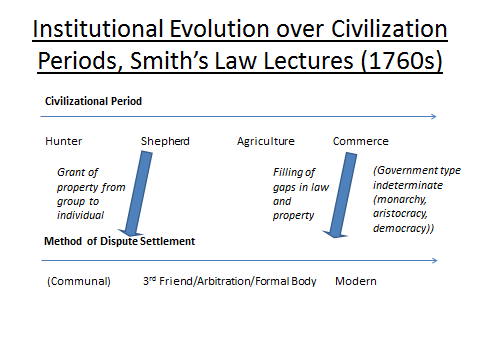
Most of these estate rights do not exist at the hunter level of civilization. Indeed, it is only with the shepherd level of civilization that the shepherd collective allows individual herdsmen to consider a hut his property, and the notions of servitudes, pledges and personal rights are created by the sovereign. While this would seem to demonstrate the state’s precedence and importance over individual contracting and property, the state is not all powerful. Indeed, in early courts, governments couldn’t compel the performance of a contract, only the payment of damages. (Smith, 1763, at 59, 69, 99, 103, and 113)

After a lengthy discourse on aspects of common law rules (marriage, contracts, etc.), Smith proceeds to examine the four stages of civilization – hunters, shepherds, agriculture and commerce – and different countries by reference to the type of government present (monarchical, republican-aristocratic, or republican-democratic). These types can be in turn distinguished by whether the judicial (dispute settlement), executive (war making) and legislative (law making) are concentrated in one person (monarchy), few people (republican-aristocratic), or all people (republican-democratic). (Smith, 1763, at 189)

Hunters have a sparse form of democratic government: dispute settlement (through death or exile) and war-making rest with the community as a whole. Legislatures do not exist, because no one would feel compelled to follow the rules. Some individuals have charismatic influence in the community, but not disproportionate power. Under the shepherd period, certain individuals begin to acquire disproportionate property. With this, inequality grows, and dependence on wealthy shepherds begins. While disputes and war-making would still be resolved by the collective, these powerful shepherds have greater-than-average sway in dispute deliberations, which they could pass to their children. But the form of government was still fundamentally democratic, Smith argues somewhat non-convincingly,[i] as the people retained the power to exile or kill. (Smith, 1763, at 189-192)

With the move into agriculture and commerce, there is greater division of labor. More commerce means more reliance on contracts and marriage agreements, but it also includes the outsourcing of public affairs to specialized groups of people. These people take on the dispute settlement function, and with this, their power exponentially grows, because disputants pay tribute to the judge. However, Smith maintains that “the people however still retained in most countries the power of appeal to themselves in all matters of moment.” Indeed, government was still seen as fundamentally weak, because disputants in court could continue to choose duels over submission to state authority. Accordingly, there are four stages of increased judicial power: 1) influential third friend settling disputes between two others; 2) an arbitrator with authority to impose gentle penalties; 3) a court that can meet out punishment for the most atrocious crimes through expelling; and 4) the modern judicial system. (Smith, 1763, at 193, 197-199)

However, the increase in arts and commerce sapped the civic engagement of the population, which led to the descent into feudalism. At this point, Smith moves beyond the idealized civilizational forms of the earlier lectures, and into the emergence of concrete judicial institutions in England. In the early medieval era, Saxon counties (organized through families in the area) resolved disputes. The centrally organized Saxon Witenagemot (followed by the Norman curia regis and eventually the King’s Bench) was the body to which appeals could be made outside of the county system, but only due to denial of justice or excessive delays of the latter. Eventually, however, the central government’s wariness of upsetting local feudal lords led to non-intervention in the system, and the decline of what Smith called the “democraticall courts.” (Smith, 1763, at 225-234)

Over the next few centuries after the Norman conquest, the curia regis split into multiple parts (Court of Common Pleas, Kings Bench, Exchequer and Court of Chancery), which Smith saw as an intentional strategy on the part of monarchs like Edward I to keep the judiciary weak. Smith appeared conflicted with regard to these developments. On the one hand, the Court of Chancery – the newest court – appeared to help innovation by allowing for the enforcement of performance of contracts and the transference of property, neither of which had been allowed under the common law. Yet Smith also regards the unchecked power of judges to innovate as a potential threat to liberty.

Smith saw several institutional factors as checks on this threat to liberty: the requirement for adherence to precedent and tradition, the rivalry between courts, the use of juries (themselves checked by requirements of juror unanimity and allowances for disqualification of jurors). At the same time, the king’s ability to corrupt jurors was limited by lifetime appointments, and out of judges’ own worry about maintaining a good reputation. Finally, Smith argued that legislatures and statutory law in commercial civilization arise in part because of the need to create additional checks on judges. (Smith, 1763, at 245-256, 276-277, 283)

Finally,Smith’s explanation of why judgments are obeyed might be derived from his overall theory of social cohesion. Contrary to social contractarian approaches,[ii] Smith believed that people join “civil society” because of two reasons: respect for authority, and because of the utility of doing so. As to the first, the poor and weak look up to the wealthy and strong, who are seen as happier. Likewise, older people may be respected on the basis of their life experience.  The rituals associated with courts and the advanced age of many justices may therefore lend to their legitimacy. Indeed, Smith wrote that continuity rather than innovation in justice was desirable:  “All new courts disdain to follow the rules that were formerly established. All new courts are a great evil, because their power at first is not precisely determined and therefore their decisions must be loose and inacurrate.” The utility reason might be described in contemporary terms as a network or imitation effect, whereby individuals’ compliance encourages others to comply: the fragility of property rights per se requires optimal compliance, and people in society in pitch in to make the law more effective. (Smith, 1763, at 280-284).

Figure 2 outlines how judicial development tracks civilizational development in Smith’s law lectures. While in parts of Smith’s writing, modern judging and the state seems to lag the development of commerce, Smith is also clear that modern judging only follows the creation of property, which is given through the coercive power of the collective. In addition to creating estate rights, the modern state later also fills in the gaps, as evidenced by the creation of Court of Chancery. Smith does not appear to believe that there is any automatic tendency to create a certain type of government, and notes that democracy both preceded and followed periods of concentrated power.


[i] On this point, Smith is inconsistent. He argues that inequality during the shepherd phase creates a need for specialized courts, and that “laws and governments may be considered in this and indeed in every case as a combination of rich to oppress the poor, and preserve to themselves the inequality of the goods which would otherwise be soon destroyed by the attacks of the poor, who if not hindered by the government would soon reduce the others to an equality with themselves by open violence. The government and laws hinder the poor from ever acquiring the wealth by violence which they would otherwise exert on the rich…” He then immediately pivots to a point about government accordingly needing to maintain the buy-in of the poor through democracy. (Smith, 1763, at 196) But if the inequality is so injurious to the poor, why would they consent through government to oppress themselves? The mechanism (which presumably rests in some form of false consciousness or manipulation) is not outlined.

[ii] Unlike other scholars of his time, Smith did not believe that government derives from a social contract, for three reasons. First, contract law as such existed primarily in England, but governments existed everywhere. Even supposing the existence of a contract at some point, nothing would bind the descendants of the parties to this contract. Finally, as for the theory that people agree implicitly to be bound by the social contract through not leaving the country, Smith noted that governments at the time restricted exit by law.

Judge knot

Judges are odd birds.

For the most part, they’re unelected. But they’re given enormous power to determine the outer bounds of the possible – both domestically (under the first ceiling), and internationally (under the second).

In a series of blog posts, I’ll be exploring some of the classic writings of the role of judges in our social life, beginning first with good ol’ Adam Smith.

++

Adam Smith was perhaps best known for his theory of the “invisible hand,” which has since been used to celebrate the social-ordering virtues of selfishness. Less well known is his considerable writing on morality, where he argued that “one’s individual merit is contingent and dependent on the happiness and merit of others” (Malloy, 1987, at 229). His 1759 Theory of Moral Sentiments outlines a preliminary model linking civilizational development to judicial-institutional outcomes, which is developed further in his 1760s jurisprudence lectures. His 1776 Wealth of Nations ­builds somewhat on this account by examining the method of financing justice.

In Smith’s Theory of Moral Sentiments, he writes that humans have made three attempts to codify moral principles: ethics (as practiced by the Ancient Greeks and Romans), casuistry (as practiced by the Catholic Church in the Middle Ages), and jurisprudence. The first is an attempt to outline broadly agreeable social expressions of the sentiments of our hearts, without any attempt to imbed them in specific social situations. The second was an attempt to make case-by-case, detailed prescriptions of how a “good man” would behave in concrete situations, irrespective of sociological context. The third endeavor is about attempting to divine general rules from nature about “what the person to whom the obligation is due, ought to think himself entitled to exact by force,” as would be confirmed by impartial spectators and judges. These enumerated “rules of justice and positive law” never perfectly attain natural jurisprudence, but are attempts to move towards it.[i]

Smith illustrates the difference between casuistry and jurisprudence by recourse to the highwayman who extorts travelers with threats to take “your money or your life.” For jurisprudence, it is clear that the “contract” that a traveler makes with such highwayman should not be enforced, because it would be adding one wrong on top of another. For the casuists, the conclusion would be less clear, since the integrity of the traveler might be undermined if his promises were not kept. In short, casuistry’s obsessive search for the chaste and virtuous response to every possible situation led to excessive precedent production that is “dry and disagreeable, abounding in abstruse and metaphysical distinctions, but incapable of exciting in the heart any of those emotions which it is the principal use of books of morality to excite.” While casuistry prescribes “rules of the conduct of a good man,” it “is the end of jurisprudence to prescribe rules for the decisions of judges and arbiters.” (Smith, 1759, at VII.VI.2 through VII.VI.33)

What explains the emergence of jurisprudence? Smith writes that governments are “under a necessity of employing the power of the commonwealth” to create it in order to prevent the confusion of vigilante justice. Indeed, governments that “have acquired any considerable authority” undertake to “do justice to all” and promise “to hear and to redress every complaint of injury.”

Smith goes on to explain variation in the quality of the judiciary across nations:

 “In all well-governed states too, not only judges are appointed for determining the controversies of individuals, but rules are prescribed for regulating the decisions of those judges; and these rules are, in general, intended to coincide with those of natural justice. It does not, indeed, always happen that they do so in every instance. Sometimes what is called the constitution of the state, that is, the interest of the government; sometimes the interest of particular orders of men who tyrannize the government, warp the positive laws of the country from what natural justice would prescribe. In some countries, the rudeness and barbarism of the people hinder the natural sentiments of justice from arriving at that accuracy and precision which, in more civilized nations, they naturally attain to. Their laws are, like their manners, gross and rude and undistinguishing. In other countries the unfortunate constitution of their courts of judicature hinders any regular system of jurisprudence from ever establishing itself among them, though the improved manners of the people may be such as would admit of the most accurate. In no country do the decisions of positive law coincide exactly, in every case, with the rules which the natural sense of justice would dictate. Systems of positive law, therefore, though they deserve the greatest authority, as the records of the sentiments of mankind in different ages and nations, yet can never be regarded as accurate systems of the rules of natural justice.” (Smith, 1759, at VII.IV.36)

Smith concludes by noting his disappointment with previous efforts to distill a universal international law of jurisprudence, noting that these efforts have focused more on what good policing (defense) demands rather than what justice demands. He promises to return to this quandary in later work.

Figure 1 outlines the theory of judicial emergence from Smith’s Theory of Moral Sentiments. The challenge for countries is to move from Nature 1 (i.e. vigilante rule, or rule by baser passions) to Nature 2 (i.e. the jurisprudence that we ought to follow reflecting a perfected state of nature). The tides of civilization and authority take countries ever closer to approximating (but never fully reaching) the ideal of natural jurisprudence. The barriers along the way are represented by the circles, and include alleged cultural, political or institutional deficiencies.


[i] Smith would later contrast ethics with jurisprudence by saying that the former is about the protection of imperfect rights, whereas the latter is about protecting perfect rights (i.e. those established by title or law).

Spoiler

Conservatives did better in Tuesday’s elections than you might think.

Why? The under-analyzed appeal of third party right-wing candidates.

First, some basic facts. While Obama is poised to get 61 percent of the electoral college vote, he only got 51 percent of the popular vote. He also got nine million less votes than in 2008 – overall, voter turnout was lower by close to 13 million, as Matt Stoller noted.

But Obama’s electoral college lead would have been lower if third party challengers did not (likely) cost Romney the electoral votes of Florida. While this would not be enough to have swung the election Romney’s way, it shows that the combined right wing party vote beat Obama in Florida – despite the obvious advantage that the Democratic guardians of social security should have among the elderly voters that matter so much in that state.

Let’s look at the House of Representatives.

The House, of course, basically didn’t change composition, with the Republicans still in control. The GOP took some hits in Illinois, Florida and New Hampshire, but made some pickups in North Carolina, Pennsylvania, Kentucky, Indiana. The end result was a net gain for the Dems of only three seats as of the moment.

But this would have been wiped away (or at least reduced to one) without the Libertarian Party. Republicans could have likely picked up Democrat John Tierney’s  House seat, and held onto Frank Guinta’s New Hampshire 1st district seat, had it not been for Libertarian Party candidates.

Turning to the Senate, the Dems had a net gain of 2 seats.

But this would have been wiped away if it weren’t for third party spoilers on the right. If not for libertarians, Republicans would have picked up an additional Senate seat in Montana, and held onto the Indiana Senate seat. The Ohio and New Mexico Senate races would have also been considerably closer.

Continue reading “Spoiler”

Most progressive Senate in history?

The most lasting contribution to history may come from outside the presidential race.

I’m talking about the Senate, where voters returned one of the most progressive cohorts in history.

Sure, it’s possible that Obama will become the radical the right warns of, or that the solidly Republican House will have a change of heart. But the most likely outcome over the next few years is more gridlock, and a simple maintenance of the wins (with all their limitations) of the 2008-10 period.

That’s why I think it’s more likely that the dividends from this election will be felt post-2014, as these mostly young senators begin to set themselves up for what could be decades of a progressive bloc in the Senate. Unlike Obama, whose political career will come to an end in 2016, these senators will be with us until at least 2018, if not much much longer.

In Massachusetts, consumer advocate Elizabeth Warren replaced Republican Scott Brown. This is the closest thing we’ll get to having Ralph Nader in the Senate, and she claims the historic mantle of progressive Ted Kennedy.

In Wisconsin, Tammy Baldwin won. She will not only be the first openly gay member of the Senate, but also a much stronger progressive than the Democrat she replaced (Herb Kohl). On the measure that I’ve followed most closely over the years (willingness to break with party leadership and corporations over trade deals), she has an 100 percent progressive voting record.

In Indiana, union-tied Joe Donnelly took the seat of Republican Dick Lugar. In New Mexico, young progressive Martin Heinrich takes the seat of outgoing (less progressive, in many respects) senator Jeff Bingaman. In Connecticut, Chris Murphy replaces arch-conservative Joe Lieberman. All three have 100% fair trade voting records.

And Sherrod Brown of Ohio and Bob Casey of Pennsylvania are returning, as is the Vermont socialist Bernie Sanders, who got one of the highest vote percentages in the country. All three are also 100% lifetime fair traders.

Conservative Democrats like Bob Kerrey, on the other hand, did not win… by a large margin. Somewhat less progressive Democrats like Shelley Berkley did not pull through in Nevada. The Montana race is still not called. Angus King in Maine is a mystery. And we’ll have to see whether Mazie Hirono in Hawaii or Tim Kaine in Virginia do a better job than the Democrats they replace.