Bitpartisan

Popular writing about neoliberalism and the U.S. party system gives a lot of blame/credit to Republicans as being the intellectual architects of programs like “bilateral investment treaties” (BITs).

Indeed, as BIT historian Kenneth Vandevelde has written, the Carter administration began kicking around the BIT concept, but it was really the Reagan administration that put bones on it. Reagan signed 10 BITs, Bush I did 15, and Bush II one-upped dad for 17 BITs (and FTAs with investment chapters) signed.

However, these apparent differences begin to fade when an adjustment is made for years in office. As Table 1 shows, Democrats were almost as likely to sign BITs, and much more likely to implement BITs, than their GOP counterparts.

In sum, the BIT program has high levels of support from presidencies of both parties – much more so than other policy areas.

Luddites: the Pretty Machine Hate with the Aftertaste from Hell

Every once in a while, the mainstream media attempts (and spectacularly fails) to describe globalization.

Today’s piece in the NYT by David Leonhardt is no exception. It explores some of the growing acceptance among economists that increased competition with lower-wage workers (surprise) negatively impacts living standards in the US.

But then it paints a naturalistic account of “globalization” as a “universal force” that cannot be remedied from Washington. (Nevermind that these patterns of low-wage competition were created by policy, nor that nations have different approaches to globalization today that seem to affect socioeconomic outcomes.)

Okay, these are all very contemporary and topical social issues, and so long as no one brings plagiarism charges against the hackneyed reporting, I guess we’ll continue to see stories like this every few months.

But there is one tic of political reporting that I would like us all to do away with, and that’s bashing of Luddites. Leonhardt reports:

Previous periods of rapid economic change also created problems that seemed to be permanent but were not. Neither the cotton gin nor the steam engine nor the automobile created mass unemployment.

“When technology reduces the need for certain kinds of labor, we know that some inventive people will one day come along and find a way to use that freed-up labor making things that other people want to buy,” said Mr. Friedman, the economic historian. “That’s what in the long run made the Luddites wrong.”

He added, “How long does it take the Luddites to be wrong — a few years, a decade, a couple of decades?”

Can we just leave these poor people alone? I know of no one that subscribes to a machine-breaking philosophy, and the last organized expression of the tradition was wiped out by execution nearly 200 years ago. By picking on people that aren’t around to defend themselves, the commentariat gets away with engaging with reality.

I can haz navy?

Billionaire Paul Singer made headlines in recent days with his company’s move to seize an Argentine navy ship off the coast of Ghana.

Singer is is founder and CEO of Elliott Capital Management, which owns the hedge fund NML Capital Limited. NML bought some of Argentina’s bonds (before and after the country’s default in its 2001-02 financial crisis), and has been attempting to collect as much payback as possible for them.

Over the next decade, NML convinced US courts and UK courts to side with its efforts, even as other bondholders settled with the government as part of a debt restructuring. The Ghanaian courts are pointing to these judgements as the reason for their authorization of the forced docking of the ship. According to The Finder newspaper,

Lawyer for the Argentine government, Larry Otu have argued that as a military vessel, the Libertad enjoyed immunity.

He argued that Article 3 of the 1996 Convention concerning the immunity of state-owned ships stipulates that state-owned ships which were not used for commercial purposes would not be subjected to arrest, and that Argentina was enjoying a sovereignty in Ghana; and even if the government has waived any immunity from pre-judgement and execution attachment of any of its asserts and properties, waiving it in Ghana will be invalid with the law.

The court, however, ruled that Argentina waived immunity as part of the agreement it entered with NML Capital in the Fiscal Agreement Agency on October 19, 1994.

Justice Adjei said even though the 2004 United Nations Convention on the law of the sea recognises the immunity of warships, that recognition was based on the rules and principles of customary international law which permits the immunity to be waived, including by contract.

This case does not directly relate to investor-state dispute settlement. Indeed, Argentina’s bond issuance terms were pretty unilaterally sovereignty sacrificing. (There are a number of closely related cases making their way through the international law realm.)

What Singer’s latest move shows however is how hedge funds are becoming increasingly sophisticated in using both developed and developing country courts, both standard judicial processes and arbitration, in order to get what they want.

The question does become, if Ghanaian courts are so reliable for international capital, why the push to allow multinationals to evade Ghana’s courts when it comes to Ghana’s regulations? Stay tuned to see if a Ghana-US bilateral investment treaty actually moves forward.

30 years of BIT magic

President Obama has occasionally drawn fire from the left for his appreciation for right-winger Ronald Reagan.

In the coming days, Obama is set to expand upon the Reagan legacy through the entry into force of a free trade agreement (FTA) with Panama.

This is nearly 30 years to the day after the Reagan administration signed a “bilateral investment treaty” (BIT) with Panama. That October 27, 1982 signing was a first for the U.S., and included many of the rights for foreign investors that are expanded upon in Obama’s latest trade deal.

The U.S. has since signed 48 BITs, and implemented 42 – most recently with Rwanda. The table below shows the total signed and implemented by year (on the left axis), and cumulative implemented on the right axis.


Continue reading “30 years of BIT magic”

Contract attack

From Marx to Hayek and in between, few would disagree that contracts form a core institutional aspect of capitalism. By allowing freely consenting adults to agree to terms of exchange, the price mechanism is allowed to flourish.

Many economists give primacy to contracts because they believe that the outcome of individuals’ freely choice is likely to be socially optimal. Libertarian political theorists, however, believe that individual freedom is a good in and of itself, irrespective of the consequence to society. Some in both camps believe that contracts can also be an institutional correction for market failure. Prisoners with incentives to rat each other out can improve their lot if they have “stop snitching” contracts. Peasants over-tilling common land can write up deeds that allow them to sell the land to the peasant with the most smokin’ business plan (with fully internalized costs!)

(These are the standard examples in textbooks, which seems kind of strange since one relates to degenerates and the other to rednecks – neither likely to be treated kindly by elite lawyers. As a Kentuckian, I of course mean both with a lotta love.)

However, social scientists and philosophers have found several reasons why the people (as expressed through the state) might want to step in the way of the right to contract.

For instance, if you’re accosted by a highway robber and given a choice of “your money or your life,” few would feel that your consent to hand over money represents a contract that judiciaries should enforce. Likewise, a worker could voluntarily contract to become a slave. But most observers would feel that the moral norms of society require non-enforcement of that contract.

These and other tricky cases are analyzed by trade lawyer Michael Trebilcock in his book, The Limits of Freedom of Contract. From a market-sympathetic point of view, Trebilcock outlines cases like prostitution, sale of human organs or monopoly contracts that should perhaps NOT be respected by the courts.

Continue reading “Contract attack”

Sweet ignorance

Global institutions could be built up or fall apart, and few would know.

At least, that’s the conclusion of Kii Runsten, a  Finnish journalist who just completed a long investigative piece through a fellowship program at University of Oxford.

She spent a year interviewing media, NGO and governmental officials involved in the globalization debate, including yours truly.

She found serious gaps in current press coverage of the World Trade Organization, for example. But she also dissects some of the partnerships and campaigns (like Oxfam’s cotton work) that seemed to cut through the media’s blindspots.

Hopefully, Kii’s piece will instigate some soulsearching among editors at the top papers. My bet, however, is that the quality and quantity of press coverage of globalization will continue to spiral down,inversely related to the skyrocketing layoffs at the major papers.

Why have second ceilings?

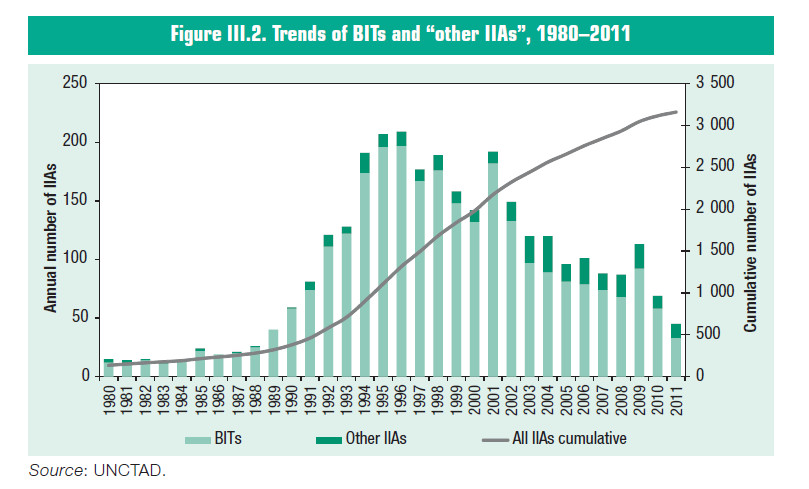
Over the last several decades, countries around the world have signed up for over 3,000 bilateral investment treaties (BITs).

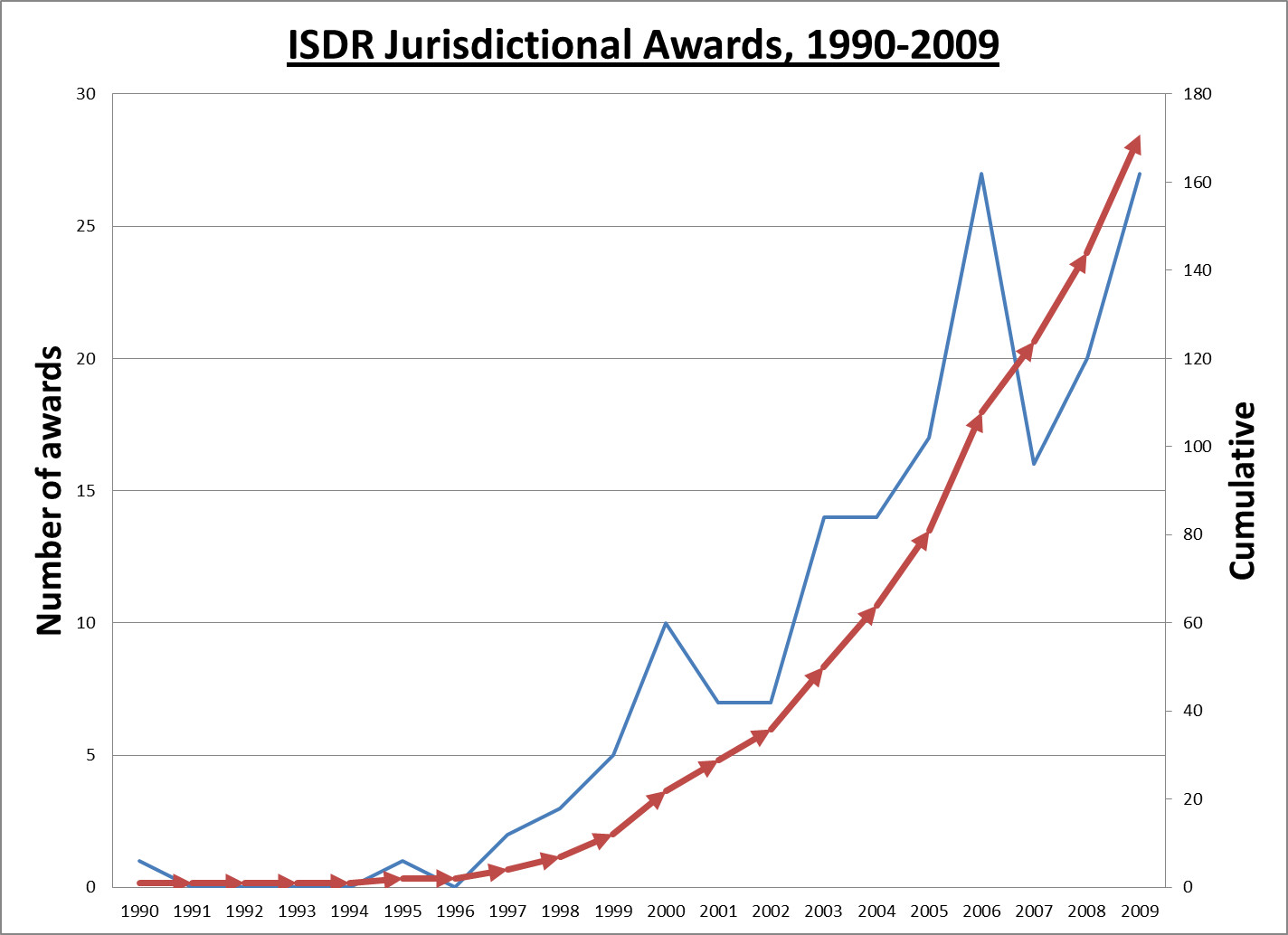
This has in turn led to a sharp increase in jurisdictional rulings…

… and of merits awards.

These deals can constitute a limitation on governments’ ability to regulate, so one would think that sovereignty-protective governments might resist them. Yet they keep signing up. Why?

Observers have offered a few theories.

Continue reading “Why have second ceilings?”

Books make you feel small

I’ve spent most of my professional career reading online periodicals and blogs, and using online databases like Westlaw. Conducting research in this fashion can make you feel powerful, like an awesome improvising chef. “Hey, I put a dash of a Supreme Court case PDF, and a whiff of a Paul Krugman column, and I produced this awesome post or memo!” The web makes you feel big, and powerful, and wise.

Fast forward to my induction to the law library today, where a librarian wistfully mentioned that many of the case law reporters are going to be taken off of the reference shelves and put into storage, “because everyone consults these items online nowadays.”

Feeling that I had limited time on a disappearing planet, I took some time this morning to explore.

Wow.

It is one thing to be able to consult excellent databases like italaw.com. But it is quite another to go through the shelves of ICSID Reports, alongside the compendiums of other case law, and touch them and feel their weight.

Online, all sources seem more or less equally credible. Online (not to mention in the thick of US politics), UN General Assembly resolutions seem pretty meaningless. But unlike political punditry, UNGA resolutions get a shelf or two or three at the top law libraries.

These stacks and stacks of books make me feel small, reminding me of how much there is left to know. While that is a bit anxiety producing, it is also inspiring – in a way that online improvisation is not.

Cue twinge of nostalgia for a rapidly fading era. But, hey, at least we’ve still got the Harry Potter robes.

Capital controls: not just for developing countries anymore

Capital controls – those pesky little speed bumps on financial and asset flows – are just something that big multinationals have to be worried about when entering poor countries, right?

Wrong.

Thanks in part to a new patchwork of anti-corruption and tax avoidance legislation, it’s becoming more difficult for even average folks to send even small amounts of money across borders.

I speak from personal experience. I’m a member of a credit union that has just moved from the U.S. to the UK. I’m renting an apartment with my wife, and needed to make two international wire transfers. The first was for the security deposit on the place, which I was sending to my new landlord. My second wire was a transfer from my US bank account to my UK bank account to have sufficient sterling-denominated funds to pay the next month’s rent.

While on paper, these transfers should take only a few business days, the reality was that they were weeks-long sagas in each case. It was a revelation of the extent to which financial flows are not all that free.

Continue reading “Capital controls: not just for developing countries anymore”

Amartya Sen and the Idea of Justice

In a world of two ceilings, how do we decide what is just? This is one of the themes of Nobelist economist Amartya Sen most recent book, The Idea of Justice.

The book takes issue with one of the prevailing notions in political philosophy, which is to assume that reasonable individuals in societies can essentially contract for idealized just outcomes. This notion was captured by Jean-Jacques Rousseau’s 1762 treatise on the social contract, and versions of it persist in more recent work, like John Rawls’ A Theory of Justice.

According to Rawls, the demands of fairness dictate what is just. Fairness in turn is defined in relation to “The original position,” when people are stripped of their social context and institutions are constructed based on the rankings of these idealized individuals. The two principles of justice that will emerge from this deliberative dreamworld are, first, basic liberties for all, and second, inequalities can be acceptable if they are attached to offices to which everyone has access under fair equality of opportunity, and they must be to the greatest benefit of the least advantaged members of society. The latter principle is evaluated on the basis of an index of “primary goods,” essentially a basket of means to accomplish ends in life.

Sen terms this general approach “transcendental institutionalism.”

Generally speaking, Sen is more interested in the realization of more just outcomes and the reduction of unjust outcomes, rather than comparing decision-making to an idealized deliberation against which any actual process come up short.

To show the shortcomings of the Rawlsian approach, Sen invokes the scenario of Anne, Bob and Carla – three children fighting over a flute. Anne could claim the right to the flute on the grounds that she is the only one who knows how to play it, so would generate more  and better  output. Bob could claim the flute because he is the poorest and has no toys, so the flute would at least give him something. Carla, for her part, argues that she made the flute, so has a right to the fruits of her labor. Perfectly reasonable utilitarians, egalitarians and libertarians could pick the side of Anne, Bob or Carla, respectively. There is not a perfect deliberative framework that can help decide which approach is optimal.

As it happens, this debate does have a fair bit of relevance for life in the global economy, where we encounter lots of situations where one nation’s decisions have negative externalities outside their own borders/polis. Many Rawlsians, with their focus on perfect institutions, are pessimistic about  the wisdom or feasibility of having democratic governance structures at the global level – apparently, the only scenario that could produce real justice. (See Thomas Nagel, here, for instance.)

Sen is more optimistic that we don’t need world government to produce more just outcomes – we can accomplish this “through public discussion” (page 26). He takes the transcendental institutionalists to task for fetishizing institutions, and for not being able to link reason to consensus on ideal institutional arrangements (especially when actual behavior is often at odds with reason). Sen feels that there is actually much to be gained from perspectives “outside” the border of the ideal deliberating state, because of the inevitability of non-internalization of all decisions’ costs outside the borders, and because comparative work can uncover the “factual presumptions that lie behind behind particular ethical and political judgments” (page 71).

I wonder what Sen would say about institutions like “investor state dispute settlement“. If such a system worked well, it could form a substitute role for world government, where reason helped guide the settlement of disputes. Indeed, it could become a sort of global deliberative role where externalities are internalized. But is the system reasonable or unbiased? Even if there is no fault in the arbiters themselves, would the faithful application of often problematic positive treaty law help enhance justice?

I’ll be expanding on Sen’s work in a number of upcoming posts, and examining its implications for life under two ceilings.