Hamas Bank Case Settled

A major terrorism- financing lawsuit was settled before a court appearance, reports Stephanie Clifford:

Last year, a jury in Federal District Court in Brooklyn found Arab Bank liable for financing terrorism by processing transactions for members of the militant Islamic group Hamas.

The second phase of the trial, assessing the damages Arab Bank would have to pay to some victims of attacks by Hamas, was scheduled to start on Monday…

The first part of the Hamas trial, which was about liability, occurred last year. Arab Bank argued that it never knowingly held accounts for terrorists. It said that it screened all of the accounts and transactions it handled against terrorist blacklists, and that the few transactions that got through were attributable to clerical errors, such as a different spelling of a name in Arabic and in English…

Banking executives said the case set a worrisome precedent, since Arab Bank seemed to follow standard screening procedures to check that its customers were not listed as terrorists. The verdict, they said, could mean banks would pull back from doing work in unstable countries, given the risk that they would later be held liable for financing terrorism.

The Obama administration had intervened in the case on the Bank’s behalf. The Solicitor General argued that Arab Bank had cooperated in anti-terrorism activities and deserved some deference.

As I wrote at the time, the whole case raised some questions about whether the US legal system was biased against financial entities from the Middle East.

With this settlement, the immediate issue seems moot. The broader question – about the consistency of punitive and unpredictable treatment of global financial services players by US courts – remains open for another day.

Sabaya Law

ISIS is trafficking thousands of female sex slaves, according to gruesome revelations by the NYT. The group’s leaders have created a theology around the abuse of Yazidis and other non-Muslim women, while killing off male members of the family.

There are many profoundly disturbing aspects of this story. But one that grabbed my attention was the relatively banal aspects of legal administration of this regime of administering slaves (or sabayas). As Rukmini Callimachi reports:

A total of 5,270 Yazidis were abducted last year, and at least 3,144 are still being held, according to community leaders. To handle them, the Islamic State has developed a detailed bureaucracy of sex slavery, including sales contracts notarized by the ISIS-run Islamic courts…

In a pamphlet published online in December, the Research and Fatwa Department of the Islamic State detailed best practices, including explaining that slaves belong to the estate of the fighter who bought them and therefore can be willed to another man and disposed of just like any other property after his death.

Recent escapees describe an intricate bureaucracy surrounding their captivity, with their status as a slave registered in a contract. When their owner would sell them to another buyer, a new contract would be drafted, like transferring a property deed.

In short, a legal system has rapidly been set up to justify a system of social domination.

But while the legal system takes away, it can also give. The story goes on…

At the same time, slaves can also be set free, and fighters are promised a heavenly reward for doing so.

Though rare, this has created one avenue of escape for victims.

A 25-year-old victim who escaped last month, identified by her first initial, A, described how one day her Libyan master handed her a laminated piece of paper. He explained that he had finished his training as a suicide bomber and was planning to blow himself up, and was therefore setting her free.

Labeled a “Certificate of Emancipation,” the document was signed by the judge of the western province of the Islamic State. The Yazidi woman presented it at security checkpoints as she left Syria to return to Iraq, where she rejoined her family in July.

Inequality Expands Role of Courts

Washington State schools face a funding crisis, as Kirk Johnson reports:

Washington State’s highest court, which has threatened, cajoled and pleaded with the state Legislature and governor for years to close the gap in spending between rich and poor schools, said on Thursday that it had finally lost its patience. In a unanimous decision, the nine-member Supreme Court imposed a fine of $100,000 a day on the state until a plan to reduce the gap was accepted, and in a written order “encouraged” Gov. Jay Inslee to call the Legislature into a special session.

The financial sanctions, which started on Thursday with the filing of the order, will be owed every 24 hours, seven days a week, with the money going into an education fund. The court said that some of the fines might be returned — for each day the House and Senate are back in session working on the problem — but only if their work resulted in what the court called “full compliance.”…

Court orders regarding education financing are not new. Kansas is in the midst of one such standoff. High courts in New Jersey and Ohio have also ordered legislatures to meet constitutional requirements. But this order, with a financial penalty imposed by one branch of state government on another, to the tune of $700,000 a week, enters new territory, legal scholars said.

“I’m not aware, ever, of a state supreme court doing this,” Scott R. Bauries, an associate law professor at the University of Kentucky who studies state constitutions and education. “I can’t see any other way of describing it — the court is appropriating funds for the education system.”

This isn’t the only manifestation of courts taking on new or enhanced social roles as inequality rises.

Research has shown that income inequality can enhance political polarization, and polarization enhances gridlock. There is some evidence that polarization in turn shifts the balance between branches of government, as Jeffrey Toobin wrote in an article last year:

“Because Congress is not working the way it’s supposed to, there’s both pressure on administrative agencies and pressure on the courts to sort through, interpret, and validate or not validate decisions that in a better-functioning democracy would be clearer and less ambiguous,” Obama said.

He pointed out that the failure of Congress to pass legislation on climate change and immigration left his Administration with little guidance on how to proceed on those issues. When there is gridlock in Congress, “the executive branch has to make a whole series of decisions,” Obama said. “That, in turn, puts more burden on the Court to interpret whether the executive actions are within the authority of the President and whether they’re interpreting statutes properly. All of which I think further politicizes the courts.”

States’ Rights, Courtesy of Feds

Historian Eric Foner takes on the states rights Civil War narrative:

… with politics today, it’s easy to say, ‘Hey, it must have been a bunch of Northern capitalists trying to control the South,’ or ‘It was just states’ rights.’ Whenever I lecture, someone raises the issue of states’ rights, and the thing I like to say is: ‘Yes, you’re right. The South believed in states’ rights. And the right they were interested in was the right to own slaves.’ And that was a right created by state law, so naturally they wanted to protect states’ rights.

And then I say, if that was really the issue, then explain the Fugitive Slave Law of 1850 to me – which was a federal law before the Civil War in terms of overriding local judicial procedures, overriding local law enforcement. Federal troops, federal marshals, going into states, you think that’s a reflection of states’ rights? No.

When it came to vigorous federal action in defense of slavery, the South was perfectly happy to go that route.

Defenders of free markets similarly obscure the substantial state intervention required to maintain them.

For more from Foner, check out the full interview in this summer’s Jacobin (uploading soon). The whole issue features historians’ reflections on the 150th anniversary of the end of the civil war.

#BlackLettersMatter

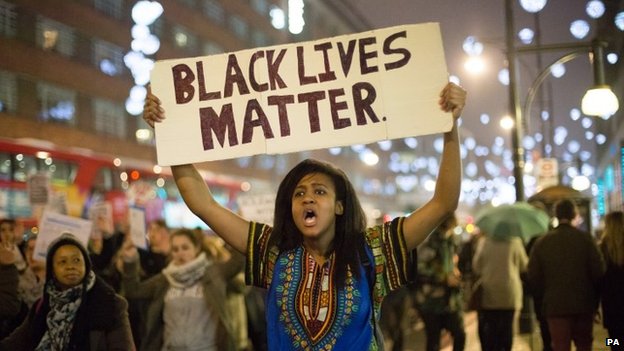
Can more precise criminal law show #BlackLivesMatter? Or is the problem fundamentally about power?

I was left pondering this after reading Jack Halpern’s excellent follow up on the Ferguson, Missouri shooting of black teenager Michael Brown by police officer Darren Wilson.

Halpern’s portrait raises some serious questions about how to characterize the role of police power in black communities. He writes:

Wilson said that, despite what he’d said about experiencing “culture shock,” race hadn’t affected the way he did 1434378589745police work: “I never looked at it like ‘I’m the only white guy here.’ I just looked at it as ‘This isn’t where I grew up.’ ” He said, “When a cop shows up, it’s, like, ‘The cops are here!’ There’s no ‘Oh, shit, the white cops are here!’ ” He added, “If you live in a high-crime area, with a lot of poverty, there’s going to be a large police presence…”… Jonathan Fenderson, who is a professor of African-American studies at Washington University, in St. Louis, told me that young black men are inclined to see the police as an “occupying force.”

Let me take this out of a realm I know nothing about (criminal justice) and into a realm I know something about (political theory, esp. international relations).

Social scientists would describe what Fenderson names and Wilson alludes to as  structural power: white people (or the rich) have power, minorities (or the poor) do not. Out of fear or profit-making needs, the rulers must police the ruled. Fans of The Hunger Games movies will recognize this story. (Sidebar: One of the most interesting debates to see play out is which type of structural power is at work: racial or economic or both. This is an old debate with some new flavor. Seth Ackerman sums up one take, and Dominique Hazard another – both compelling.)

But Halpern points us towards some aspects of the Ferguson story that are not only/ primarily about structural power.

Continue reading “#BlackLettersMatter”

Integrate U

Australia is considering softening its opposition to investor-state dispute settlement (#ISDS) in the Trans-Pacific Partnership (TPP), according to Primrose Riordan of the Financial Review.

This topic is one of the sticking points in the stalled negotiations, alongside more traditional trade concerns like dairy market access.

Further complicating the talks is the sheer number of negotiating partners. Twelve countries are involved in the talks. Many of them – like the US, Canada and Mexico – already have preexisting trade and investment deals of their own.

But there are gaps in the coverage. For instance, while the US and Australia have a trade deal, it does not permit investors from each country to directly challenge the other country’s regulations in arbitration tribunals.

How much would the TPP further integrate investment governance in the Asia-Pacific region?

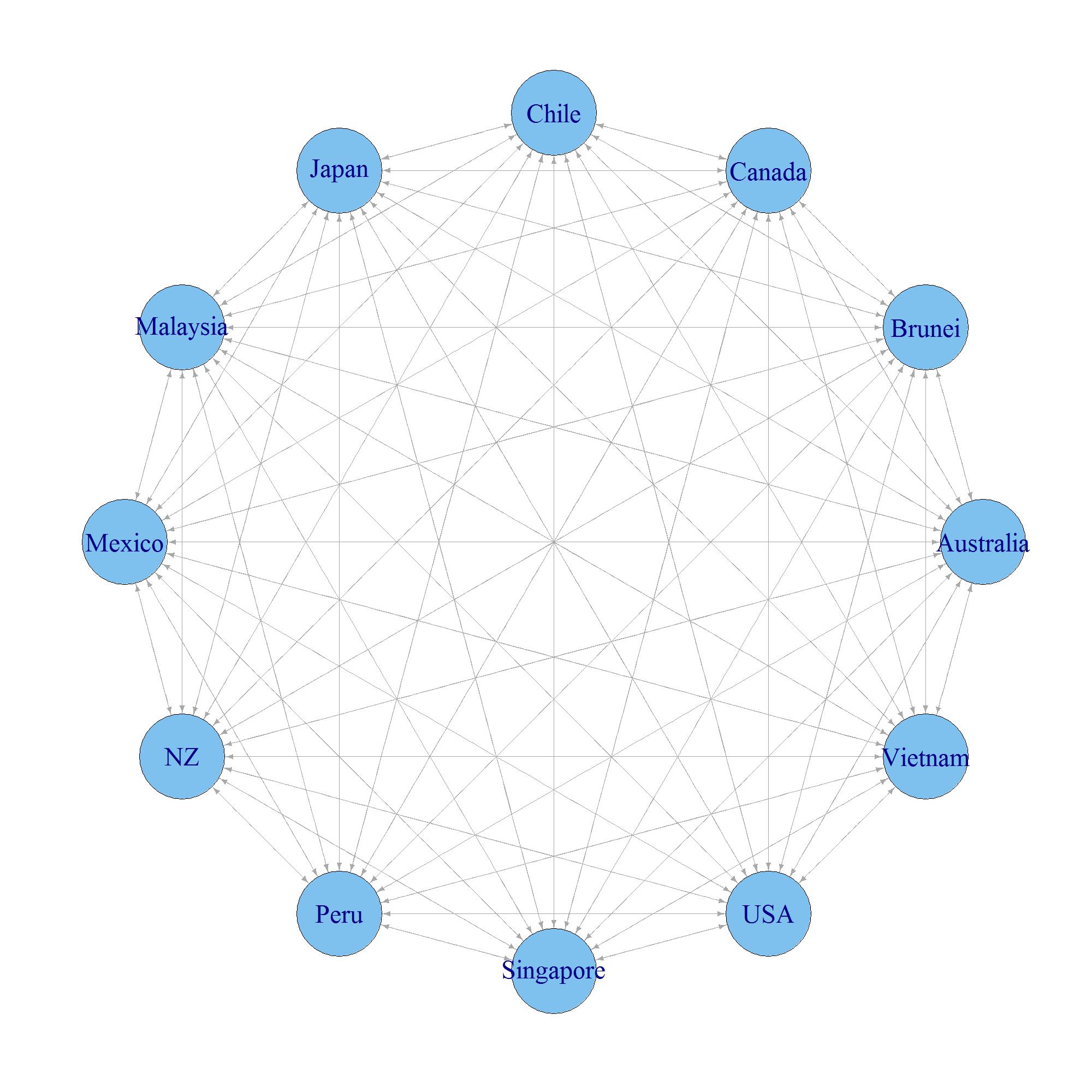
To get a sense, I compared the country pairs at the TPP talks that already allow investor-state dispute settlement between them, versus those that would newly allow it under 12-way integration. The first figure here is the “before” picture, which I constructed using UNCTAD’s data on investor-state agreements.*

pre_TPP

At the moment, only 35 country pairs have treaties.

Here’s what the graph would look like after 12-way integration:

post_TPP

The “after” picture is much more integrated. Indeed, we would nearly double the number of bilateral treaty equivalents to 66.

While treaty negotiators think in terms of the number of country relationships cemented, this is not the most useful way of thinking about investor-state disputes. Clever investors can already figure out ways to game the status quo. As Sergio Puig writes, investors have tactics at their disposal to milk the network for all it is worth, including forum shopping, party shopping, relief shifting and more.

For example, a US investor could attack an Australian regulation by registering a Peruvian subsidiary and going through that. This despite there being no Australia-US investment pact. According to the World Bank’s rankings, it is as quick or quicker to get a business registered in many TPP target countries as it is in the US. So this type of nationality planning is not far-fetched – especially for a big enough dispute that might justify the re-registration transaction costs.

In short, the TPP would make certain disputes easier. They could be launched with less shopping around. But the basic architecture making these disputes possible is already in place.

++

*I used only those agreements UNCTAD listed as investment treaties (or trade pacts with ISDS). This metric might overstate the number of current treaties. Jason Yackee, for instance, has suggested UNCTAD’s statistics do not always clearly distinguish between pacts that have and don’t have ISDS.  I excluded pacts labeled as TIFAs or EPAs, which do not typically grant investors standing.

#DefaultNotDefault

Puerto Rico missed a payment on its bonds yesterday. In other words, a “default”, right? Maybe not, as Mary Williams Walsh reports:

…the bonds that defaulted on Monday were sold with a guarantee, in the form of an irrevocable letter of credit issued by the Government Development Bank.

The letter of credit made the bonds look safer. It said that in the event the Public Finance Corporation failed to make a payment, a trustee for the bondholders would be able to draw the money owed them from the Government Development Bank.

But as investors have prepared for the default, they learned that the bonds’ prospectus does not describe this safety feature the same way the bonds’ indenture does, leaving confusion about what it takes to activate the letter of credit, or whether the guarantee is meaningful at all.

Officials in Puerto Rico have said that the bonds were backed by yearly budget appropriations, and that if an appropriation did not happen, the bonds would not be paid that year and the holders would have no legal recourse — in effect, there would not be any default to cure.

…investors might have to file suit in a Puerto Rico court to get a declaration of default, and there was no guarantee that the court would issue one. Then Puerto Rico might be able to turn around and sue the investors, saying their accusations of default had caused it irreparable legal and financial harm.

In other words, bondholders must rely on the munificence of judges whose salaries come from the Puerto Rican government to rule against said government. Seems unlikely.

Say the Supreme Court of Puerto Rico ruled against the bondholders, or, what’s more, held them responsible for harming territorial interests. The court decision would be reviewable by the US Supreme Court. But this would be a long legal road for bondholders, and loads of uncertainty and expense.

If any of the bondholders were from a country with a US investment agreement, this elongated procedure (if not the default and/or SCPR court excusing of it) would seem ripe for an investor-state complaint. If Puerto Rico were challenged, the US government (that didn’t bail the territory out and whose courts might even side with the bondholders) would be tasked with defending it.

Given US courts’ hardline on Argentina’s default, this would be quite a role reversal!

Bolt to the Future

I don’t often agree with John Bolton, but he is asking some of the right questions on the Iran deal.

W’s ambassador to the UN has a column in today’s NYT. In it, he shakes his bellicose fist at the Obama administration’s most significant diplomatic accomplishment. He chastises them for not credibly keeping the option of war on the table, as he has in past columns where he urged bombing of Iran.

Setting aside these reckless recommendations from a man who never saw wartime action, his latest column poses systemic issues worth considering.

First, setting aside war, what is to keep Iran from violating the agreement? The re-imposition (snapback) of the sanctions that effectively brought Iran to the negotiating table. But there are reasons to think this won’t work as planned:

For the president’s predictions of Iranian behavior to come true (and they are central to successful implementation), Tehran must recognize the inevitability of the pain their country will suffer for straying from compliance.

Yet the very language of the Vienna deal demonstrates the opposite. In two provisions (Paragraphs 26 and 37), Iran rejects the legitimacy of sanctions coming back into force. These passages expressly provide, in near identical words, that “Iran has stated that if sanctions are reinstated in whole or in part, Iran will treat that as grounds to cease performing its commitments under this JCPOA” — Joint Comprehensive Plan of Action — “in whole or in part.”

Thus the inexorable pattern will not be: Iran violates the deal; sanctions snap back; Iran resumes compliance. Quite the reverse. The far more likely future is: Iran violates the deal; sanctions snap back; Iran tells us, using a diplomatic term of art, to take our deal and stuff it.

Abrogating the deal, of course, would come only after Iran had reaped the economic benefits of having its assets unfrozen and the sanctions ended. The Europeans (among others) will have been suckered back into economic relationships that will cause as much pain to them as to Iran if they are abandoned. Sadly, the ayatollahs know the Europeans better than Mr. Obama does.

This last point is worth emphasizing. The sanction regime against Iran was painstakingly constructed over many years. The US succeeded in getting allies to respect it, in part through tough penalties for any multinational company also doing business in the US. Iran’s economy was deep in the doldrums as a result of this regime. Once sanctions become dismantled, and European companies (and others) rush in, they will become lobbyists against re-imposition of tough sanctions. And, if Bolton’s predictions are true, it won’t matter much anyway – if Iran has already gotten what it wants.

Without war, sanctions are the stick the administration would have to wield. If you share Bolton’s assumption that Obama (or future administrations) will not use force under any circumstances, then you should be worried about this. I think he is wrong on this. I instead worry that future sanction ineffectiveness will make war more inevitable.

Bolton also critiques procedural aspects of the deal, including lengthy “dispute resolution” mechanisms that he likens to a “a diplomatic La Brea Tar Pit”.

And what if Russia and China block re-imposition of sanctions? How Obama addressed this possibility is Bolton’s real worry:

Under the deal and Security Council Resolution 2231, if a JCPOA party asserts that a significant violation has occurred, then the council must vote within 30 days on whether “to continue the sanctions lifting.” Thus, in theory, if Washington alleged a breach, Moscow and Beijing would have the burden of keeping the sanctions lifted, rather than Washington having the burden of reinstituting them. Absent a resolution “to continue the sanctions lifting,” sanctions snap back.

By concocting a procedure that elides the Russian or Chinese vetoes, Mr. Obama has surreptitiously accomplished a prized objective of the international left, which always disapproved on principle of the veto power. Through 70 years of United Nations history, one lodestar emerges clearly: Washington’s only immutable protection has been its Security Council veto. Mr. Obama’s end-run around the veto poses long-term risks that far outweigh whatever short-term gain is to be had from boxing in Russia and China now.

What Bolton calls a “dangerous precedent” will be celebrated by many in developing countries, who have long seen the US veto at the UN as locking in various “Washington consensuses” over the years.

But he is right to raise our eyes above the short-term diplomatic quandary at hand. More focus on long-term governance might have avoided the current Greek crisis, and the backlash against international economic regimes.
Clusterfakis

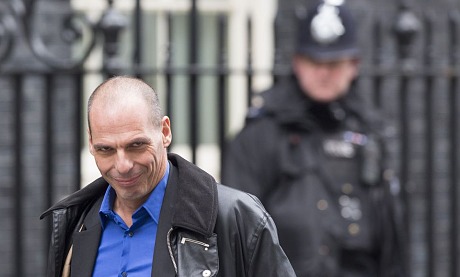
Yanis Varoufakis, Greece’s radical ex-finance minister, was the subject of an excellent New Yorker profile by Ian Parker.

Particularly fascinating are the details on ways economists, lawyers and politicians varied in their approach to the Greek crisis.

For example, after Yanis told the other Eurozone finance ministers (including Germany’s Wolfgang Schauble) that Greek obligations were to inflexible and that his Syriza party had been elected to break with austerity…

Varoufakis recalled that Schäuble seemed “very cross,” and said, “When there’s a program that everybody has tumblr_nj96laH7YX1un5qroo1_500agreed to, that’s it. Elections cannot change anything, because, then, every time there’s an election everything will change.” (A spokesperson for the German finance ministry said, “Meetings of Eurogroup finance ministers are confidential.”) As Varoufakis put it to me, the idea that elections could change nothing was the “greatest gift one could give to the Chinese Communist Party.” That’s overheated, of course, and democratic governments tend to respect the binding agreements signed by their predecessors. But it was interesting, at Brookings, to hear Schäuble say that “France would be happy if someone could force” its parliament to pass unpopular labor-market reforms. It wasn’t quite clear what Schäuble meant by “France,” if it was neither its people nor its parliament…

Varoufakis said, he’d found no market in Europe for such thoughts. At the level of the Eurogroup, Varoufakis told me, the conversation was “all about the rules.” It was not a forum in which to discuss debt unsustainability, or the rarity of economic growth under austerity conditions. Varoufakis told me that he was “accused of talking about economics.” Once, Varoufakis was asked what Greece’s target surplus should be, if not 4.5 per cent of G.D.P. He “had to give a lecture” about the variables that made the question unanswerable in that form. “They’re not economists,” Varoufakis said. “Most of them are lawyers.”…

According to a Eurogroup official, Varoufakis “didn’t seem to understand that the other people in the room were constrained by their national parliaments. They are bound by certain treaties. Those constraints fly in the face of pure economics. The eurozone is complicated, and he had no understanding or sympathy for that.”…

In the opinion of one troika official, Varoufakis’s disregard for the granular—like the ease with which he requested other European taxpayers to settle Greece’s account—had an undemocratic air. “One may dismiss this as technocrats looking at numbers,” the official said. “But, if something doesn’t add up and there is a gap, the gap has to be financed by somebody.” He went on, “Adding up is the essence of democracy.”

To recap, according to Eurozone officials:

  1. Elections shouldn’t have international consequences.
  2. On the international plane, states are unitary actors across time and space – even if what we mean at cocktail receptions when we name a country is shorthand for its banking class.
  3. Domestically, democracy is about numbers. Making budgets balance. Any cross-subsidization internationally disrupts the democratic pact.
  4. However, the people’s representatives in this numerate democracy need not themselves be numerate. Instead, they are lawyers that can put legal rules and procedures above basic economics.

Is it just me, or does this seem like a regime so complex that we simultaneously get the worst of democracy, economics, and the law?

Stock-Blocking the Bailouts

The government’s bailout of insurance company AIG was illegal, according to a US judge’s decision last month. The decision is just a latest example of the consequences of delegating adjudication over complex regulatory questions to the legal profession.

A bit of background. The case was launched by AIG’s shareholders in the wake of the financial crisis that brought the company and global economy to its knees. Spearheaded by AIG’s former CEO and largest shareholder Maurice Greenberg and his company Starr International, the plaintiffs alleged that the government’s takeover of AIG’s management and absorption of 80 percent of the company’s shares constituted an illegal taking of shareholder property.

Media and pundits had denounced the claim as frivolous for much of the proceedings. However, Greenberg was represented by the best lawyers money can buy, led by David Boies, who has argued huge Supreme Court cases over the 2000 presidential election, and gay marriage. But some observers – including those familiar with the adventurous claims made in investment treaty arbitration – found it harder to so easily dismiss the claim.

Judge Thomas Wheeler’s decision essentially split the baby. First, he found that the AIG takeover was not a regulatory taking of property, but rather an illegal exaction. The liability implication for the government is essentially the same in either case, but the judge argued that – to be considered a taking – there must be a legally authorized government action in question, which Wheeler found the takeover was not. (More on that later.) Second, because AIG stock was essentially worthless at the time of takeover, the government – although it behaved illegally – did not owe any money to the shareholders. Predictably, both sides are appealing the split decision. Wheeler’s full decision is available here. I have a few takeaways. Continue reading “Stock-Blocking the Bailouts”