New article II

Nicole Janz @PolSciReplicate, Michael @Colaresi and I have new articles in the International Studies Perspectives journal’s special symposium on replication and transparency in academic research. Recent scandals over questionable research underscore the importance of the topic.

Here’s the abstract for my article, which looks at an oft-neglected aspect of the transparency debate:

The paradigm wars between quantitative and qualitative methodologists have focused on the validity and reliability of theory testing, with increasing concerns for transparency in both types of work. But not all research topics lend themselves to theory testing and, rather, require the generation of new theoretical concepts. The relative lack of attention to the “why” and “how” of qualitative theory generation has stunted innovation, forcing scholars to avoid such work or “reinvent the wheel” rather than build on community accomplishments. This article shows that grounded theory methods from sociology provide useful techniques for theory generation and can help scholars break through theoretical muddles. These methods have the added benefit of utilizing a workflow management that lends itself to more transparency than is common in much qualitative work. This article concludes by suggesting steps to boost transparency for grounded theory in international relations and push out the knowledge frontier.

Nils Weidmann has a concluding article where he expands on these ideas:

Because of the problems that might arise in extending replication to data generation
and management, most contributors agree that for quantitative analyses, the replication material should include the replication data set and code to generate tables and figures. For qualitative analysis, replication is considerably more difficult. Some of the articles in this forum provide helpful suggestions for improving transparency at various stages of the research process. Tucker (2016) proposes to apply grounded theory used for theory building in sociology to inter national relations research. Although this does not imply that more, and other types of, replication material would be distributed along with the article, it does mean that the article itself will be much more detailed when it comes to the statements from which theory is derived.
I highly recommend all the pieces in the symposium forum, which brings together papers presented at the 2014 International Studies Association annual meetings in Toronto. Nicole organized both endeavors with Nils Petter Gleditsch. Alexia Katsanidou, Laurence Horton, Uwe Jensen, and Fernando Martel García also made contributions.
The idea for my article came out of a replication workshop I took with Nicole. The piece started off as a replication of a quantitative analysis on investment treaty outcomes, and ended up a conceptual piece on qualitative research.
If you’re interested in further reading on grounded theory, one of the creators of the school (Anselm Strauss) and Juliet Corbin have a comprehensive “how to” book from 1998. Josh Karton applies grounded theory to contract arbitration research. And Jorg Friedrichs and Friedrich Kratochwil have a great piece on methodological pragmatism in qualitative research more generally, a tradition of which grounded theory is a part.

Theories of change

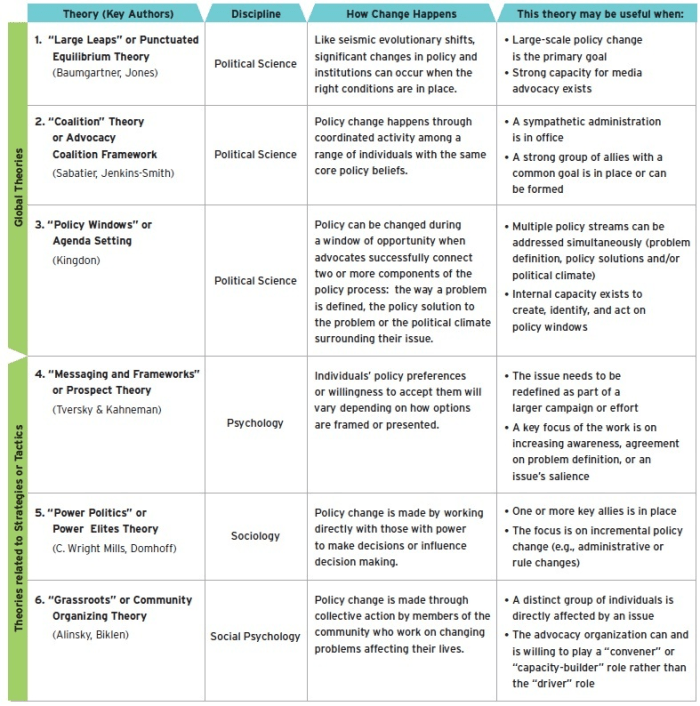
I’ve been reading up recently on different theories of social change across academic disciplines. Sarah Stachowiak has a very accessible report on this topic, articulating what lot of practitioners probably take for granted.

If 30 pages is too much for you to read, this graph captures it all pretty well, distinguishing between Baumgartner and Jones’ large leaps/ punctuated equilibrium theory, Sabatier and Jenkins-Smith’s coalition theory, Kingdon’s policy windows theory, behavioralists’ messaging theory, Mills’ power politics, and Alinsky’s grassroots organizing theories.

image001

New article

I have a new article out in the latest issue of the Journal of International Dispute Settlement. It is entitled “Inside the Black Box: Collegial Patterns on Investment Tribunals,” and here is the abstract:

This article examines the collegial dynamics within investment tribunals. I construct a qualitative typology of adjudicator-level interactions based on original interviews with arbitrators from over 90% of finalized investment arbitrations. I proceed in several steps. First, I present an empirical and theoretical background on investment arbitration governance. Second, I give an overview of my data collection and method. I then present eight ideal types of arbitrators, which vary by their tilt towards states and affinity for each other. I then consider 128 distinct tribunal combinations, for which I explore the implications for states. I conclude that collegial dynamics contribute to making awards more investor-friendly or fact specific. The article contributes to the judicial politics and judicialization literatures by providing a case study of collegial dynamics among a class of adjudicators that lack tenure.

The article is part of a special issue on empirical research on investment treaties. Cedric Dupont and Thomas Schultz have a great introductory article, where they kindly summarize a major takeaway of my study:

The crucial and usually forgotten question about arbitrators, Tucker essentially
explains, is how likely they are to influence the other two arbitrators on the tribunal,
and not only in which direction they are likely to pull. Their likely persuasive effectiveness depends, among other things, on how willing they are to try, for reasons of personality but also other interests of their own, and how persuasive they can be if they do try.

Do World Bank ranking improvements attract FDI?

These days, I steer clear of debates about estimating the impact of trade agreements. Any public policy conversation that rapidly devolves into whose unrealistic assumptions are better seems like a debate better had behind closed doors at econ seminars and ComicCon. I’ll stick to the text of the agreement, which I can simply read in a single PDF file, thank you very much.

However, Simon Lester highlights an interesting aspect of a recent Peterson Institute study on the TPP. The study attempts to estimate how many non-trade barriers (i.e. regulations and other government actions) might be “actionable” under the agreement. The authors then project increases in FDI that might be triggered by removal of these regulations.

Like Simon, I read the original Peterson report. Like Simon, I don’t understand the non-trade barrier aspect of it.

According to researchers at Tufts University, who analyzed the previous Peterson report on TPP…

The results obtained by  Petri, Plummer and Zhai ( 2012)  depend strongly on the  projected  increase in foreign direct investment, estimated to generate , on average, 33 percent of the TPP ’s  total income gains…

Given  the  difficulty  of  predicting  FDI  flows,  the  authors  estimate  the  FDI  effect through  two series of assumptions . First, the potential increase in FDI stocks is estimated through a parameter  that expresses the impact of changes in the World Bank Doing Business rank. The parameter is  the  same  for  all  participating  countries, implying  the  same  increase  in  stock  of  FDI  for  any  country  that climbs  a  given  number  of  ranks.  Once  the  parameter  is  estimated,  it  is  used  to  calculate  the  potential  change  in  FDI  stocks.  It  is assumed that  signing the  TPP will  put  all  countries above the  ninetieth  percentile of the ranking , and that all FDI stocks will increase  by  at   least  50  percent  of  the  difference  between  the  predicted  level  and  their  current  level. Secondly,  the  “actual”  FDI  increase  is  calculated  from  the  potential  increase , assuming  that the  TPP investment  provisions  eliminate a  maximum  of  two – thirds of  investment  barriers  and  that  each  country  achieve s this , depending  on  the  number  of  FDI  provisions  it  accepts. This  procedure  is  used to  justify the  assumption that  FDI  will  play  a  major  role  in  making the  TPP economically  successful…

I don’t know if a similar procedure is used in the more recent Peterson report, and it’s difficult to compare since the methodology appendices the Tufts crew refer to are not freely available online. (And the Tufts study doesn’t provide page citations, so you can’t reverse engineer through Google Books.)

In any case, the point about the World Bank Doing Business rankings caught me eye, and comes perilously close to my current research interests on investment.

It turns out that the link between changes in World Bank’s rankings and FDI are anything but clear. World Bank economist Dinuk Jayasuriya found the following:

for the average country,  [marginal] improvement in the official Doing Business Rankings is likely to  increase FDI into a country…  Nevertheless, there  appears  to  be  no  evidence  to  suggest  large  improvements  in  Doing  Business  Rankings… attract significantly greater FDI inflows. When  focusing  on  developing  countries  in  isolation, the  relationship  is  insignificant.

In other words, in estimates that included rich countries, minor increases in DB rankings helped things. But when rich countries are taken out of the sample, there’s no benefit to moving up the ranking ladder. And countries don’t appear to get more FDI when they make a lot of improvements rather than just a little.

Similarly, a more recent study by Adrian Corcoran and Robert Gillanders concluded:


Regulation has been found to matter for local investment and entrepreneurship and
in this paper we have sought to empirically assess the proposition that better
business regulatory environments, as defined by the World Bank’s Ease of Doing
Business measure, will attract more foreign direct investment. Using data on a large
proportion of the world’s countries we found evidence that this was true on average.
Going deeper, we found that most of this effect can be explained solely by how easy
it is to trade across borders, with other components of doing business having little or
no effect. We also found that the effect was not present in the world’s poorest, and
therefore most eager for FDI, region, Sub-Saharan Africa. Neither was it present for
the OECD.

Again, there are heterogeneous effects depending on what region of the world you are in. And the regulations related outright to trade were more important than those indirectly related, i.e. purely domestic regulations that might affect longer term FDI.

I’m thankfully not a macro or trade modeler – see minutes 5 in this video for Adam Posen’s take on the difference (and minutes 1:40-1:50 for an impromptu debate between Tufts and Peterson folks).

But an emerging literature suggests we don’t yet know much about how FDI is affected by policy changes that are inherently difficult to put into numbers.