Blog

Will EU Investment Tribunal Be Better than #ISDS?


If European officials have their way, we could see several new international courts in the near future.*

The immediate impetus for the proposals is a popular backlash in many European countries against aspects of a proposed trade deal with the U.S. called the Trans-Atlantic Trade and Investment Partnership. The TTIP would include rights for investors to directly sue governments for cash compensation over treaty violations. While similar so-called investor-state dispute settlement (ISDS) rules have been included in over 1,000 European trade deals (many with poorer nations), the prospect of tens of thousands of litigious U.S. investors suing more regulation-friendly European governments has brought the reciprocal nature of these rules into sharper focus.

In response to these fears, European Union officials are proposing to create standing tribunals to hear ISDS cases. A few notable features include:

  • A lower court composed of judges with six to 12- year terms. Five would come from the U.S., five from the E.U., and five from other countries. One judge from each nationality group would be randomly assigned to each case that was filed. The chair would come from neither country (i.e. a judge from Japan or a less developed country, etc.). This would replace the current ISDS system, where arbitrators are appointed by investors and states on a case-by-case basis.
  • A higher court that would hear appeals from litigants dissatisfied with the decisions of the lower court. The appeal tribunal would have six judges with similar nationality and case assignment rules as the lower court. At present, ISDS rulings are final and un-appealable. Nonetheless, there are some procedures that somewhat resemble appeal. Cases that take place at the World Bank’s arbitration facility can be annulled in certain extreme situations;** cases heard elsewhere can be set aside in national courts. The EU’s proposed appellate body would be able to review a wider range of both legal and severe factual errors by the lower tribunal.***

The European Commission is touting these a a “clear break” from the past and a move towards “system comparable to that found in domestic legal systems.” They’ve already incorporated the proposals into a trade deal with Canada called CETA.

How you assess these proposals depends on your metrics. Judicial politics scholars have assessed quality of judicial systems along a number of dimensions: independence, legitimacy, and effectiveness / authority. Let’s take a look at each in turn.

Independence

A system of tenured arbitrators seems more independent at first blush than a system that gives litigants control over who judges them. Indeed, scholars that agree on little else (see here and here) agree that lack of tenure is one of the top ways states can keep international tribunals dependent. For example, when judges on the European Court of Human Rights approach have passed their final reappointment opportunity, they show more willingness to vote against their home country.

But independence is not just a formal quality of how judges are appointed: it is the ability of adjudicators to produce opinions by their own discretion and autonomously from the preferences of other political actors. You could have a system of tenured judges that nonetheless delivered according to the preferences of a group in society. You could also imagine a system of untenured arbitrators that voted their own conscience rather than follow their appointers’ desires. An example of the former would be when hired-for-life U.S. judges systematically favor the “haves” over the “have nots.” An example of the latter might just be ISDS, in the view of some scholars, as ISDS tribunals regularly split the difference between states and investors. As I show in my own research, judges that operate in multi-member tribunals will show varying degrees of independence, and may limit their own preferences in order to reach bargains with one another.

Legitimacy

Legitimacy refers to the subjective belief by stakeholders that the proposed investment court has a right to exercise authority over investment rules – even when they might disagree with specific decisions. Legitimacy can be thought about from the perspective of the general public, states, and investors.

As political scientist Erik Voeten has written, the general public is unlikely to pay close attention to what goes on at faraway courts. If this is true with the EU’s ISDS appeals tribunal, then the problem won’t be legitimacy but ignorance. If the public were to suddenly become interested, perhaps because of a highly salient / controversial case, then the tribunal’s legitimacy would hinge on how trusting citizens were of institutions associated with the tribunal (like the E.U.) or of courts more generally.

Would the proposed investment tribunal be more legitimate in the eyes of states or investors?

Maybe. As Sergio Puig finds, one of the main predictors of getting appointed to an ISDS tribunal is an arbitrator’s connection to other influential arbitrators. That arguably could produces an inward-looking dynamic that limits broad legitimacy. Perhaps a more institutional bench would inspire greater confidence.

But maybe not. In the current system, states and investors get to pick the arbitrators that hear their case. This may give both sides greater confidence that their views will be heard. In contrast, the members of the new ISDS tribunal would not be picked by either litigant, and the chair would not even come from either country.  the deciding vote on an ISDS tribunal would be cast by someone who was not picked by either side, or even a national of either side’s home country. They might make them less legitimate in the eyes of the litigants.

Sometimes too much independence leads to legitimacy problems. For instance, many Caribbean countries used to allow appeals of domestic legal decisions to the Privy Council of the House of Lords in the UK – their erstwhile colonial master. This body is very independent, in that the local population has no control over its members. As Larry Helfer explains, the Privy Council’s imposition of its own anti-death penalty preferences damaged its legitimacy among Caribbean countries that still used the punishment. The countries responded by removing this appeal option and setting up their own regional court of appeals.

More dense connections to local actors can help build legitimacy. James Cavallaro and Stephanie Brewer find that the Inter-American Court of Human Rights gets more country compliance with its decisions when the public in the affected country is exposed to its cases through local media. More broadly, Yonatan Lupu tells us that both national and international courts track closely their own approval ratings and that of other branches of government before deciding cases.

In short, judges rule more acceptably with they know what constitutes public acceptability.

Effectiveness and Authority

The tension between independence and legitimacy leads to the final metric: effectiveness. This can be thought of either in internal or external terms.

Internally, does the court discharge its case load quickly? This is not a great indicator, since a court could be very efficient in terms of producing written decisions, but completely ignored.

The external effectiveness might be more important: do parties comply? Effectiveness is closely related to the concept of authority. As Karen Alter, Larry Helfer, and Mikael Madsen write

Most ICs acquire formal legal authority—what many call de jure authority—through an act of delegation from states that establishes the courts’ “right to rule” on disputes falling within their jurisdiction… But delegation alone is insufficient. A formally constituted court may receive no cases even if violations of the law are widespread. Or it may issue decisions that the parties ignore or that have no legal or political impact. The core challenge that ICs face, therefore, is transforming formal legal authority into authority in fact, what many label as de facto authority

Unlike legitimacy, authority is not subjective. As Alter et al find in a just released special issue of the journal Law & Contemporary Problems, authority exists on a spectrum. Some courts have no authority, like the East African Court of Justice (which has been largely disregarded by the business interests it was meant to help). A court can have narrow (or intermediate) authority, where only the litigants to a case (or potential litigants) follow the rulings (e.g. the Caribbean Court of Justice). The Andean Tribunal of Justice has more extensive authority, in that it shapes actual business practices by litigants and non-litigants alike. Finally, popular authority exists when the public as a whole accepts bindingness and enforceability of rulings (e.g. the U.S. Supreme Court on a good day).****

By this metric, the new ISDS system will be at least as effective as the old one. Both entail governments giving advance consent to be sued, and neither requires that the host state voluntarily comply. Enforcement happens by victorious investors taking arbitration awards to national courts (often in third countries). In the U.S., judges are instructed to defer to the legal reasoning of arbitrators. And while foreign sovereign assets were once considered immune from attachment in litigation, this has been wittled away in U.S. courts in recent decisions.

Indeed, there’s a chance that the new system could be more authoritative than the current ISDS system, in that its independence and tenure might allow it to promote more uniformity in the case law. This could then allow potential litigants to have greater certainty about whether a claim would be frivolous or not – making better use of scarce resources by not pursuing frivolous or misguided cases.

Conclusion

The E.U. proposal to create a new investment court will be at least as (if not more) authoritative as the current ISDS system. On its face, it will also be more independent. However, more independence and authority may not lead to more legitimacy in the sense that I’ve outlined above. This is based largely on my read of the literature and history of the WTO’s dispute settlement body – on which the E.U.’s proposal is partly based.

Later this week, I’ll take a closer look at the WTO. And after that, I’ll also draw some lessons on how to create a better balance between the goals of enhancing authority, legitimacy, and independence.

+++

Footnotes

* I use the terms “courts” and “tribunals” (and “judges” and “members of appeal tribunal”) interchangeably.
** The grounds for annulment are contained in ICSID Convention Article 52, and include:

– that the Tribunal was not properly constituted;
– that the Tribunal has manifestly exceeded its powers;
– that there was corruption on the part of a member of the Tribunal;
– that there has been a serious departure from a fundamental rule of procedure;
– that the award has failed to state the reasons on which it is based;

*** The enhanced grounds for appeal in the EU proposal include:

(a) that the Tribunal has erred in the interpretation or application of the applicable
law;
(b) that the Tribunal has manifestly erred in the appreciation of the facts, including
the appreciation of relevant domestic law; or,
(c) those provided for in Article 52 of the ICSID Convention, in so far as they are not
covered by (a) and (b).


In other words, there is a more explicit allowance in the new proposal for revising the legal and factual decisions made by the lower tribunal. However, as legal scholar Christoph Schreurer (unhappily) notes, annulment committees have been able to use the vague language of the ICSID Convention to review legal and factual findings of ISDS tribunals.

**** There’s no easy relationship between independence and authority. A state would comply with a court that always sided with states, since that would imply no behavioral change. It would probably never comply with a court that ruled against it unfairly. In between, evenhandedness might help with states that value evenhandedness domestically, and not with those that don’t.

Relatedly, a system that was totally predictable and evenhanded would never be used, as cases could be easily settled. It would be difficult to definitively ascertain the authority of a court that never ruled, and broad public legitimacy concerns would not even arise. Linking compliance to behavioral change is conceptually tricky, especially in a world where remedies don’t entail policy change.

In short, it’s complicated.

++

10:17 am: a few edits made for clarity.
Cosbrella Clause

The NYT reports that Bill Cosby is funding his litigation expenses in a creative manner:

In defending himself against lawsuits from women who say he sexually assaulted and then defamed them, Bill Cosby is facing mountainous legal expenses.

Luckily for him, he has homeowners’ insurance.

That is the surprising tool Mr. Cosby is using to pay his legal fees as he battles defamation claims filed by 10 women in three states.

Mr. Cosby’s insurer, American International Group, better known as A.I.G., has gone to court to deny him coverage, arguing, among other things, that it should not have to cover claims that arose from alleged acts of sexual misconduct.

Cosby is not alone. Bill Clinton and OJ Simpson also defrayed legal expenses through their homeowners insurance. How does one get such stellar coverage? Back to the NYT:

The typical homeowner’s policy covers bodily injury, the sort of claim that arises when the mail carrier slips on your broken front stoop. But many wealthy Americans, with assets to protect, often pay for enhanced “personal injury” clauses or umbrella policies that provide coverage in a range of other circumstances, including lawsuits that accuse the policy holder of defamation. Two decades ago, the insurance industry estimated that seven million people in the United States held such umbrella policies, although the Insurance Information Institute said it does not have current estimates.

Umbrella clauses are common in a number of legal instruments. While contracts typically specify some obligations rather precisely (“Smith will deliver X amount of corn to Jones on X date”), drafters often include some vague terms that can be stretched to cover unanticipated events.

Umbrella provisions allow judges and other adjudicators to fill in gaps in the contractual canvas, and to take account formal commitments between the parties that showed up in other legal instruments.

The problem becomes when the gaps swallow the canvas. Legal scholar Raul Pereira de Souza Fleury recently examined the umbrella clause under investment treaties, and found that investment arbitrators had ruled all over the map:

For the tribunals in Joy Mining v Egypt and CMS v Argentina, the key factor that would decide whether the contract breach should be equated to a treaty breach was the nature and magnitude of the State’s interference with the contract.

On the other hand, tribunals dealing with identical umbrella clauses in similar cases reached the opposite conclusion, giving full effect to the umbrella clause. In SGS v Philippines… the tribunal held that Philippines’ obligation to pay the sums owed to SGS, arising out of a service contract, fell within the scope of the BIT’s umbrella clause. According to the tribunal, the umbrella clause ‘provide[s] assurances to foreign investors with regard to the performance of obligations assumed by the host State under its own law with regard to specific investments’….

However, the broadest and more literal applications of the umbrella clause were made in Eureko v Poland… In Eureko the tribunal … held that:”[T]he plain meaning – the “ordinary” meaning – of a provision prescribing that a State “shall observe any obligations it may have entered into” with regard to certain foreign investments is not obscure. The phrase “shall observe” is imperative and categorical. “Any” obligations is capacious; it means not only obligations of a certain type, but “any” – that is to say, all obligations entered into with regards to investments of investors of the other Contracting Party.”

There’s a certain logic to these clauses – a contractual promise is a promise. There’s just two problems. First, less formal communications like campaigning promises or prior regulatory schemes sometimes get interpreted as contractual promises – which they plainly would not be under most domestic legal systems. Second, states might make promises in different forums for strategic reasons. For example, a state might make a big promise (lock in of taxation rates) to induce a foreign investor to invest, but choose to make that under a domestic legal contract that would be interpreted by a deferential national court rather than a less deferential foreign treaty tribunal. While you could say that was a sleazy move on the state’s part, it’s also one that the investor signed up for if their initials are on the contract. Caveat emptor!

The predictably unpredictable spread in the investment treaty case law has already led some countries to dial back the language in their newer treaties. As de Souza reports:

before 2004, 34 of [the US’] 41 BITs contained an umbrella clause that read ‘[e]ach Party shall observe any obligation it may have entered into with regard to investments’. By contrast, in its 2004 and 2012 Model BITs, the US eliminated the customary umbrella clause and instead, the model BIT provides a strict limitation of investment agreements (Article 1) whose breach may be submitted to arbitration, namely: (i) natural resources; (ii) supply of utility services; or (iii) performance of infrastructure projects… the investor must waive its rights to other remedies, in order to pursue such arbitration claim.

Will this be a new era of more spelled out contracts and treaties? Bill Cosby and other beneficiaries of vague/encompassing language probably hope not!

Would a Trump or Sanders Trade Policy Create Jobs?

Bernie Sanders scored a major upset in Michigan on Tuesday, leaving statisticians scrambling to explain their failure to predict it.

Bernie’s victory has been attributed to his willingness to call out Hillary Clinton for her past support of trade agreements like NAFTA and the TPP. This is a horse that Donald Trump has already been riding to victory across the early primary states. Some have even suggested that this shared critique gives Sanders a tool to beat back a Trump presidency that Hillary could not credibly wield.

What are their positions on trade? Trump has vacillated between celebrating globalization, to calling trade deals like NAFTA and TPP disasters, bashing trade negotiators as idiots, to pledging a 20 percent tariff on all imports, to a 35 percent tax on Mexican goods, to a 45 percent tariff on Chinese goods, to declaring China a currency manipulator, to deploying the U.S. military to the area to bully China at the trade negotiating table. For his part, Sanders has proudly touted his votes against each trade deal that came before Congress during his time in office, and led the effort to repeal permanent normal trading relations with China. According to his  campaign website, he pledges to reduce inequality by

Reversing trade policies like NAFTA, CAFTA, and PNTR with China that have driven down wages and caused the loss of millions of jobs. If corporate America wants us to buy their products they need to manufacture those products in this country, not in China or other low-wage countries.

The two candidates have noticed their close alignment on this issue, with Trump telling reporters

“Well it’s very interesting that you say that, because the one thing we very much agree on is trade,” Trump said on CNN’s “State of the Union.” “We both agree that we’re getting ripped off by China, by Japan, by Mexico, by everybody we do business with.”…

“The difference is, I can do something about it. I’m going to renegotiate those trade deals and make them good – and, believe me, they’re going to be really good,” he said.

“Bernie can’t do anything about it, because it’s not his thing,” he added. “He won’t be able to do anything about it. I’ll create absolute gold out of those deals, whereas right now we’re losing tens of billions and even hundreds of billions of dollars.”

“I will create gold, and Bernie will just talk about how bad they are.”

Are these plans feasible? As a technical matter, a Bernie presidency could withdraw from NAFTA and the WTO on six months’ notice. Re-negotiation would be harder, in that our major trade deals involve many countries, and a super-majority of countries (if not all) would have to sign off for any changes. Negotiators have spent over 15 years trying to conduct a new round of WTO negotiations, to very little success. And if you ask for something, you’re going to have to give something. Would Sanders or Trump allow other countries to violate U.S. copyrights in exchange for higher steel tariffs? Maybe. Or would some other sector of the U.S. economy pay for the trade-off?

More importantly, would these plans be effective in creating jobs? I think of the trade-jobs link as involving three policy options: the ineffective, the indirect, and the direct.

Continue reading “Would a Trump or Sanders Trade Policy Create Jobs?”

How can governments deal with #ISDS claims?

Political scientist Julia Calvert has conducted field research in Ecuador and Argentina on governments’ strategy when being sued under investment treaties. In the latest issue of Investment Treaty News, she offers some advice to government officials based on these countries’ experiences:

First, skill up to better argue your case. Develop in-house government capacity to contest the claims that come, so that you are not reliant exclusively on foreign counsel.

Second, use your leverage as the state to try to get investors to renegotiate contracts on favorable terms, or otherwise avoid arbitration.

Third, use every defense at your disposal, even if some seem iffy to your legal counsel. Better to use and fail, than to not attempt.

Fourth, push for annulment and set aside of every award. Cases heard at the World Bank’s ICSID facility allow for in-house review, while other cases can be reviewed by national courts. The standards for setting aside an award are demanding. But again, better to try than not.

All of the above strategies add to investors’ transactions costs, and lower the utility of using ISDS mechanisms. Calvert provides examples of each of these strategies working in Argentina. She also provides examples of them backfiring: Argentina’s pushy tactics with contract re-negotiations got the government in trouble with a number of investment tribunals.

Fifth, politicize the disputes. This is the real novel prescription that Calvert makes, one beyond the standard legal advice that predominates the debate. Her academic research shows that Kirchner and Correa were able to use the disputes as populist punching bags to rally support for their governing agenda. This is the mirror image to the regulatory chill argument we more commonly hear. We might call it regulatory mobilization.

Sixth, try to withdraw from treaties. But as she notes, this is hard to do. Poland just announced it would try to do this, but the treaties are good for years if not decades after the formal cancellation announcement is made. Most governments won’t incur exit costs (e.g. capital flight, reputational sanctions) for sovereignty benefits that accrue so far into the future (read: to future administrations).

With thousands of these pacts in place, and the cost-benefit analysis tilted against renegotiation, Calvert’s research provides a set of pragmatic tools for governments on the receiving end of legal claims.

Of course, for each one of these mechanisms, investors have their own. Litigation/political strategy cuts both ways!

New article II

Nicole Janz @PolSciReplicate, Michael @Colaresi and I have new articles in the International Studies Perspectives journal’s special symposium on replication and transparency in academic research. Recent scandals over questionable research underscore the importance of the topic.

Here’s the abstract for my article, which looks at an oft-neglected aspect of the transparency debate:

The paradigm wars between quantitative and qualitative methodologists have focused on the validity and reliability of theory testing, with increasing concerns for transparency in both types of work. But not all research topics lend themselves to theory testing and, rather, require the generation of new theoretical concepts. The relative lack of attention to the “why” and “how” of qualitative theory generation has stunted innovation, forcing scholars to avoid such work or “reinvent the wheel” rather than build on community accomplishments. This article shows that grounded theory methods from sociology provide useful techniques for theory generation and can help scholars break through theoretical muddles. These methods have the added benefit of utilizing a workflow management that lends itself to more transparency than is common in much qualitative work. This article concludes by suggesting steps to boost transparency for grounded theory in international relations and push out the knowledge frontier.

Nils Weidmann has a concluding article where he expands on these ideas:

Because of the problems that might arise in extending replication to data generation
and management, most contributors agree that for quantitative analyses, the replication material should include the replication data set and code to generate tables and figures. For qualitative analysis, replication is considerably more difficult. Some of the articles in this forum provide helpful suggestions for improving transparency at various stages of the research process. Tucker (2016) proposes to apply grounded theory used for theory building in sociology to inter national relations research. Although this does not imply that more, and other types of, replication material would be distributed along with the article, it does mean that the article itself will be much more detailed when it comes to the statements from which theory is derived.
I highly recommend all the pieces in the symposium forum, which brings together papers presented at the 2014 International Studies Association annual meetings in Toronto. Nicole organized both endeavors with Nils Petter Gleditsch. Alexia Katsanidou, Laurence Horton, Uwe Jensen, and Fernando Martel García also made contributions.
The idea for my article came out of a replication workshop I took with Nicole. The piece started off as a replication of a quantitative analysis on investment treaty outcomes, and ended up a conceptual piece on qualitative research.
If you’re interested in further reading on grounded theory, one of the creators of the school (Anselm Strauss) and Juliet Corbin have a comprehensive “how to” book from 1998. Josh Karton applies grounded theory to contract arbitration research. And Jorg Friedrichs and Friedrich Kratochwil have a great piece on methodological pragmatism in qualitative research more generally, a tradition of which grounded theory is a part.

Theories of change

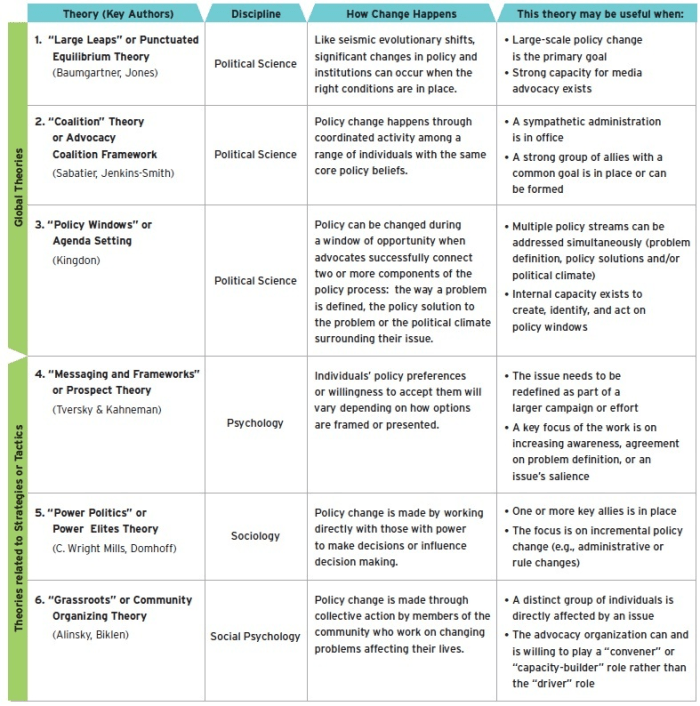
I’ve been reading up recently on different theories of social change across academic disciplines. Sarah Stachowiak has a very accessible report on this topic, articulating what lot of practitioners probably take for granted.

If 30 pages is too much for you to read, this graph captures it all pretty well, distinguishing between Baumgartner and Jones’ large leaps/ punctuated equilibrium theory, Sabatier and Jenkins-Smith’s coalition theory, Kingdon’s policy windows theory, behavioralists’ messaging theory, Mills’ power politics, and Alinsky’s grassroots organizing theories.

image001

New article

I have a new article out in the latest issue of the Journal of International Dispute Settlement. It is entitled “Inside the Black Box: Collegial Patterns on Investment Tribunals,” and here is the abstract:

This article examines the collegial dynamics within investment tribunals. I construct a qualitative typology of adjudicator-level interactions based on original interviews with arbitrators from over 90% of finalized investment arbitrations. I proceed in several steps. First, I present an empirical and theoretical background on investment arbitration governance. Second, I give an overview of my data collection and method. I then present eight ideal types of arbitrators, which vary by their tilt towards states and affinity for each other. I then consider 128 distinct tribunal combinations, for which I explore the implications for states. I conclude that collegial dynamics contribute to making awards more investor-friendly or fact specific. The article contributes to the judicial politics and judicialization literatures by providing a case study of collegial dynamics among a class of adjudicators that lack tenure.

The article is part of a special issue on empirical research on investment treaties. Cedric Dupont and Thomas Schultz have a great introductory article, where they kindly summarize a major takeaway of my study:

The crucial and usually forgotten question about arbitrators, Tucker essentially
explains, is how likely they are to influence the other two arbitrators on the tribunal,
and not only in which direction they are likely to pull. Their likely persuasive effectiveness depends, among other things, on how willing they are to try, for reasons of personality but also other interests of their own, and how persuasive they can be if they do try.

Do World Bank ranking improvements attract FDI?

These days, I steer clear of debates about estimating the impact of trade agreements. Any public policy conversation that rapidly devolves into whose unrealistic assumptions are better seems like a debate better had behind closed doors at econ seminars and ComicCon. I’ll stick to the text of the agreement, which I can simply read in a single PDF file, thank you very much.

However, Simon Lester highlights an interesting aspect of a recent Peterson Institute study on the TPP. The study attempts to estimate how many non-trade barriers (i.e. regulations and other government actions) might be “actionable” under the agreement. The authors then project increases in FDI that might be triggered by removal of these regulations.

Like Simon, I read the original Peterson report. Like Simon, I don’t understand the non-trade barrier aspect of it.

According to researchers at Tufts University, who analyzed the previous Peterson report on TPP…

The results obtained by  Petri, Plummer and Zhai ( 2012)  depend strongly on the  projected  increase in foreign direct investment, estimated to generate , on average, 33 percent of the TPP ’s  total income gains…

Given  the  difficulty  of  predicting  FDI  flows,  the  authors  estimate  the  FDI  effect through  two series of assumptions . First, the potential increase in FDI stocks is estimated through a parameter  that expresses the impact of changes in the World Bank Doing Business rank. The parameter is  the  same  for  all  participating  countries, implying  the  same  increase  in  stock  of  FDI  for  any  country  that climbs  a  given  number  of  ranks.  Once  the  parameter  is  estimated,  it  is  used  to  calculate  the  potential  change  in  FDI  stocks.  It  is assumed that  signing the  TPP will  put  all  countries above the  ninetieth  percentile of the ranking , and that all FDI stocks will increase  by  at   least  50  percent  of  the  difference  between  the  predicted  level  and  their  current  level. Secondly,  the  “actual”  FDI  increase  is  calculated  from  the  potential  increase , assuming  that the  TPP investment  provisions  eliminate a  maximum  of  two – thirds of  investment  barriers  and  that  each  country  achieve s this , depending  on  the  number  of  FDI  provisions  it  accepts. This  procedure  is  used to  justify the  assumption that  FDI  will  play  a  major  role  in  making the  TPP economically  successful…

I don’t know if a similar procedure is used in the more recent Peterson report, and it’s difficult to compare since the methodology appendices the Tufts crew refer to are not freely available online. (And the Tufts study doesn’t provide page citations, so you can’t reverse engineer through Google Books.)

In any case, the point about the World Bank Doing Business rankings caught me eye, and comes perilously close to my current research interests on investment.

It turns out that the link between changes in World Bank’s rankings and FDI are anything but clear. World Bank economist Dinuk Jayasuriya found the following:

for the average country,  [marginal] improvement in the official Doing Business Rankings is likely to  increase FDI into a country…  Nevertheless, there  appears  to  be  no  evidence  to  suggest  large  improvements  in  Doing  Business  Rankings… attract significantly greater FDI inflows. When  focusing  on  developing  countries  in  isolation, the  relationship  is  insignificant.

In other words, in estimates that included rich countries, minor increases in DB rankings helped things. But when rich countries are taken out of the sample, there’s no benefit to moving up the ranking ladder. And countries don’t appear to get more FDI when they make a lot of improvements rather than just a little.

Similarly, a more recent study by Adrian Corcoran and Robert Gillanders concluded:


Regulation has been found to matter for local investment and entrepreneurship and
in this paper we have sought to empirically assess the proposition that better
business regulatory environments, as defined by the World Bank’s Ease of Doing
Business measure, will attract more foreign direct investment. Using data on a large
proportion of the world’s countries we found evidence that this was true on average.
Going deeper, we found that most of this effect can be explained solely by how easy
it is to trade across borders, with other components of doing business having little or
no effect. We also found that the effect was not present in the world’s poorest, and
therefore most eager for FDI, region, Sub-Saharan Africa. Neither was it present for
the OECD.

Again, there are heterogeneous effects depending on what region of the world you are in. And the regulations related outright to trade were more important than those indirectly related, i.e. purely domestic regulations that might affect longer term FDI.

I’m thankfully not a macro or trade modeler – see minutes 5 in this video for Adam Posen’s take on the difference (and minutes 1:40-1:50 for an impromptu debate between Tufts and Peterson folks).

But an emerging literature suggests we don’t yet know much about how FDI is affected by policy changes that are inherently difficult to put into numbers.

Review: Road from Mont Pelerin

What is “neoliberalism”, and who is responsible for it? Economist John Williamson once wondered whether it was anything “more than an intellectual swear word.” Certainly on the left, certainly outside the US, that is how it used. Take a typical Bernie Sanders tirade against “corporate power”, substitute “neoliberal power”, and you’ve got the flavor.

51iy3hzxybl-_sy344_bo1204203200_A recently republished volume tackles this question from the careful perspective of expert historians and scholars. While neoliberalism is today laid at the doorstep of Ronald Reagan and Margaret Thatcher, “The Road from Mont Pelerin: The Making of the Neoliberal Thought Collective” retraces the origin story back to 1947. That was the year that a group of upstart libertarian-leaning scholars met in Switzerland to found the Mont Pelerin Society. Centered around economist and philosopher Friedrich Hayek, the academic/social convening group would go on to cultivate Nobel Prize winning economists and the leaders of today’s top right-leaning and libertarian think tanks.

The book is edited by Philip Mirowski and Dieter Plehwe. They pull together case studies on the origins of the movement in France, UK, US, and Germany; and the impact of the movement on Chile, Peru, and the UN.

The best chapters cover the evolution of Mont Pelerin thinking on core issue areas -labor unions, corporate monopolies, and economic development. Spoiler alert: libertarian positions on these questions were more varied than they appear today.

Take the chapter on unions. Yves Steiner shows that Swiss and German participants in the 1947 Mont Pelerin conference approved of unions as a tool to re-educate workers about market-favoring values. Contracting between private-sector unions and private-sector employers could also foreclose the need for intervention by state labor ministries. However, a wave of labor legislation in the US prompted American participants to see matters differently. Unions were only possible, in this story, due to the state sanctioning of the coercive closed shop. This coercion against the individual leads to monopolies, which in turn lead to inflation. In the end, US-based scholars – and their patrons from Dupont (which underwrote some MPS events) – won the day.

A similar transformation took place with anti-trust. The chapter by Rob Van Horn shows that Chicago-based economists and German “ordoliberals” in the 1930s and 40s agreed that the state should be active in breaking apart large monopolies – a threat to competition. By the 1950s, however, Chicago economists came around to the view that competition between firms would eventually destroy monopolies, and competition within firms for control would similarly have a salutary effect. Also, they suggested that politicians and courts where too quick to find monopolies were none could be proven. In short, governments’ hamfisted efforts to curtail monopoly would simply take us further from the market – which is to be avoided.

Finally, chapters by Plehwe and Jennifer Bair convincingly detail the almost accidental neoliberal interest in economic development – an association that is now most prominent. Early MPS scholars were more preoccupied with the threat of communism than developmentalist states. The first several MPS meetings did not even feature papers on development. But in 1949, Truman made his famous four points speech advocating state-facilitated aid and development; in the following years, interventions by Argentine economist Raul Prebisch and Bandung Conference participants would argue for the necessity of import substitution-led industrialization. These events grabbed MPS leaders’ attention. They realized that the frontline of the intellectual debate over the role of the state in economies was going to be happening in the Third World, where (thanks to decolonization) there were now many more states to curtail. By 1958, Dupont and other corporate leaders had funded a conference at Princeton University to focus intellectual energy on development issues.

These early MPS development interventions were more philosophical than economic, arguing that lazy cultural traits and politics would get in the way of growth and state-led industrialization. Instead, poor countries should be satisfied with their place in the global value chain, whether as sources of cheap labor, natural resources, or agricultural commodities. If technocratic dictatorships had to tamp down popular demands for a different path, so be it.

It took decades before the spirit of Bandung percolated up into the international governance space more substantially. The New International Economic Order debates at the UN were made possible by the growing political might of oil producing states in the 1970s. By then, MPS members had honed their  development critique -and were ready to play the influence game in Washington and other capitals.  The rest is history.

Pair this book with Steve Teles’ Rise of the Conservative Legal Movement: you’ll get a good sense of how leveraging university affiliations, government connections, business dollars, and good old-fashioned “bro’ing out” at nice Swiss resorts provide the cement for lasting hegemonic influence.

UPDATE: A few passages show how neoliberals are not totally anti-state; they need a certain type of state. For French neoliberals, “the state creates the framework within which competition is free. It begins to clarify what a neoliberal state must be: a regulator that punishes deviations from the ‘correct’ legal framework.” (p.50) In the German ordoliberal tradition, weak states were those “incapable of defending against the united onslaught of interest crowds. The state is pulled to piece by avaricious interests”. In contrast, they wanted a strong (or “total”) state that could protect itself against democratic demands (p. 111). In other words, courts!

Review: Hidden Wealth of Nations

Gabriel Zucman (@gabriel_zucman) has put out an anti-tax haven manifesto, The Hidden Wealth of Nations.

His major contribution is to assemble in a one-stop, accessible history of tax havens, and an estimate of how much they cost the public. Based on copious statistical research, Zucman estimates $7.6 trillion (or eight percent of global wealth) is held in tax havens. A third of this is held in Switzerland, which plays a fulcrum role for other tax havens around the world. All of this adds up to $190 billion in lost tax revenue. For comparison purposes, this is over 40 percent the size of the US government deficit.

Against narratives that the status quo is a free market outgrowth, Zucman demonstrates zucman2015bookcoverthe key role of public institutions. Swiss banks, for example, were made profitable on the basis of deposits by the Swiss government, which moreover served as a lender of last resort. The governments of Panama and other tax havens mounted complementary tax haven industrial policies. Moreover, Switzerland’s foreign policy of neutrality amounted to another form of subsidy, as it could attract deposits other nations couldn’t. Finally, the US and other Allied Powers allowed Swiss banks to misrepresent assets’ true owners, giving up the massive leverage they had at the end of World War II to force a clean-up of questionable accounts.

By highlighting the key role played by the state, Zucman opens up a clear reform path. Much as governments made choices to only lightly regulate and cooperate on tax haven activity in the past, they can make a decision for more robust governance in the future.

His recommendation: to unify and expand private depositaries of wealth into a public global utility. This recommendation is not surprising: Zucman’s focus is above all on data collection. But he pairs it with a recommendation to levy trade sanctions on tax havens equivalent to their contribution to tax avoidance.

While this proposal will have its detractors in the international trade law bar (which tends to favor liberalization over other goals), Zucman’s economic logic is unassailable. Simply put, current government policy subsidizes tax havens – re-balancing sanctions would better approximate the free market outcome. He makes some attempt to square this with WTO rules, but his conclusion about EU constraints is blunt – kick tax havens out the EU, on the logic that they’ve commercialized (and thus forfeited) their sovereignty.

Although not a major focus of the book, Zucman alludes to the role of victimhood discursive strategies employed by the wealthy in their fight against accountability. For many years, Swiss banks sold financial secrecy as a protection for persecuted minorities in other countries, such as (in an earlier era) victims of the Holocaust. Whatever the ethics of this strategy, Zucman shows there’s weak empirics: Holocaust victims’ accounts were very few compared to those of standard tax avoiders. It’s an interesting sidebar – one with clear parallels in the investment arbitration space. There, narratives of human rights protections for victims of government abuse help justify a system that seems more geared towards business interests than protecting regulatory space.

Zucman’s major contribution is to bring some of Jeremy Bentham into the debate on multinational taxation. Bentham famously thought that the law should be simple and easy for everyone to understand. As a participant on the margins of the tax debate, I find most interventions anything but. With an economy of words (the book is only a bit over 100 pages, and the font is big!), he cuts through the legalese and economese to offer some valuable pearls of wisdom.